Showing posts with label dystopian. Show all posts

Tuesday, May 05, 2015

Book Review: An Ember in the Ashes

An Ember in the Ashes

by Sabaa Tahir

Told in alternating stories of two main characters on opposite sides, An Ember in the Ashes is a suspenseful exploration of the effects of violence on both the conquered and the conquerors. Set in a Rome-like fantasy world, the Scholars are a subjugated people under the rule of the Martials. Laia is a Scholar living with her brother and grandparents. When her brother is arrested on suspicion of being a member of the resistance, and her grandparents are killed violently by Martial soldiers, Laia runs away in fear. To atone for her cowardice, Laia sets out to save her brother, and goes undercover as a slave to the cruel and sadistic commander of the elite military academy Blackcliff.

Elias is a student at Blackcliff, training to become a Mask, the most elite of Martial soldiers. Although he has lived most of his life as a student under the harsh discipline at Blackcliff, Elias still sees things differently than his peers because he spent the first six years of his life outside the Martial society. Elias is determined to escape the violent society and his role as an enforcer as soon as he graduates. Then a visit from the Augurs — the Martial's version of oracles — puts a difficult choice before Elias. But can he trust the prophecy, or is he being manipulated by the Augurs?

Sabaa Tahir was inspired to write An Ember in the Ashes during her time at the Washington Post's foreign desk, when she was exposed to horrifying stories of the effects of violence on people around the world. An Ember in the Ashes is an exciting dystopian story that shows how a violent society affects everyone, from the slaves to the highest levels. Even the resistance is divided by the question of whether they have an obligation to help those of their people in need, or whether such aid detracts from their mission of fighting back against the Martials.

I had some minor credibility problems, and the plot development was occasionally awkward. I thought that the addition of supernatural characters like djinn was an unnecessary device that muddies the waters. The augurs were fine and really drive the plot in many ways, but the djinn and other spirits made it start to feel like everything was thrown in, including the kitchen sink.

This isn't a subtle book: the message about the effects of violence is hammered pretty hard. However, as I write this in a Baltimore (and a nation) trying to figure out how to police our communities without unnecessary violence by police against the people they are supposed to protect, the message really resonates.

In spite of the minor issues, I found An Ember in the Ashes to be a thrilling and highly engaging plot-driven story with loads of teen appeal, especially for fans of dystopian fiction like the Hunger Games. I can understand why it's been optioned for film already.

Diversity

Elias is described as having golden-brown skin. The identity of Elias' father is unknown, but it's likely that his skin color came from his father, since his mother is described as having pale skin. Other than that, skin color doesn't seem to play a role, although one of the more despicable characters is also described as having dark skin. The Martial empire appears to be generally diverse, with various ethnicities of people coming from the different conquered nations, although it's not significant to the plot.

Although the empire appears to be fairly patriarchal, female characters play a significant role. Besides Laia, there's Helene, who is also a student at Blackcliff and Elias' best friend. Helen is one tough cookie, in some ways one of the toughest students there. In spite of that, though, she's mostly relegated to the traditional female support role, and a subplot about an attraction leaves her acting "like a girl." There's also the female commander of Blackcliff, and several minor female characters including a cook who used to be an explosives expert.

The author is a woman of color.


Who would like this book?

Anyone who enjoys a thrilling, suspenseful plot-driven story, particularly fans of The Hunger Games and other dystopian fiction. In keeping with the theme, An Ember in the Ashes is fairly dark and violent, so sensitive readers may want to take a pass.


Buy from Powells.com:


FTC required disclosure: Review copy sent by the publisher to enable me to write this review. The bookstore links above are affiliate links, and I earn a very small percentage of any sales made through the links. Neither of these things influenced my review.

Friday, February 13, 2015

Book Review: The Last Wild/The Dark Wild

I read both of these books together, so I'm going to do what I rarely do and review them together. If you haven't read the first book, you might want to stop after my review of The Last Wild, because my review of The Dark Wild will, of necessity, have spoilers for the first book.


The Last Wild
by Piers Torday

In a dystopian future, all animals have died out from an illness called "red-eye" that mutated to spread throughout the animal populations. The only animals still living are a few hardy species like cockroaches. Even the bees are dead, which means that there are no more food crops. The only food left is a synthetic food called Formul-A, and the only supplier of Formul-A is the Facto corporation, essentially giving them control of the remaining human population.

Twelve year old Kester Jaynes has been incarcerated in Spectrum Hall Academy for Challenging Children for six years. The Academy is just as horrible as its name makes it sound: the children live regimented, restricted lives, and breaking the rules is punished by solitary confinement. Kester can't even complain: he hasn't been able to speak since his mother died. The words just won't come out.

Kester keeps company with a cockroach at lunch, but one day he's surprised to hear the cockroach speaking to him in his head. Shortly after that, one hundred pigeons break through his window and help him escape from Spectrum Hall. Kester discovers that Facto lied: the animals are not all dead. There is a group of them — a Wild — still living on the edge of civilization, and Kester has a unique ability to talk to them through a kind of mental connection. Between the red-eye virus and the cullers sent out by Facto to kill any remaining animals, the Wild is in grave danger. Kester sets off with the pigeons, the cockroach, a stag, and a wolf cub to find his father, who used to be a vet, and try to find a cure for the red-eye.

If all this sounds a bit unbelievable, it is, but that's ok. This isn't the kind of book that has to be realistic. The characters and the situations are somewhat exaggerated, like you might find in a Roald Dahl or a Lemony Snicket book, with the same kind of dark humor found in those books.

The main characters are Kester and a girl named Polly, whom he meets along the way, and various animals. Kester and Polly are good characters, but the animals are really the best thing about this book. Torday has done an outstanding job of giving the animals unique voices that really fit their personalities. Kester develops through the story, as he learns to be self-reliant and to take responsibility.

The pacing is good, and the plot keeps you turning pages, as Kester, Polly and the animals go from one situation to another as they try to make their way to the city to find Kester's dad. The Last Wild is a unique and interesting book, and a good read. I've read a lot of books, and I can honestly say that I haven't read anything quite like it.

Diversity?

There isn't really any diversity that I saw in the book. In fact, in a few cases I was bothered that some of the villains had impediments or physical characteristics exaggerated in a negative way for comic effect. For example, the evil headmaster stutters.

Who would like this book?

Middle-grade readers, particularly those who like animal fiction. Be aware that The Last Wild is a dark book, and there are deaths; some animals are killed by evil people in front of Kester and Polly. Sensitive children who are bothered by such things may want to give it a pass.

I suspect that this book would have strong appeal for fans of the Warriors series. It's a very different kind of book, but I think that Warriors fans would appreciate not only the animal characters, but also the dark conflicts in a dangerous world, the Wild community, the theme of personal sacrifice, and the well-paced plot.


The Dark Wild
by Piers Torday

Kester and Polly have saved the Wild, and helped Kester's dad find a cure for the red-eye virus. But the Facto corporation isn't going to give up their control of the world and everything they've worked for so easily. Selwyn Stone, the head of Facto, wants something more than to kill all the animals. He wants what Polly has, the secret she swore to her parents that she'd never reveal.

Other factions are also after the secret, and Polly escapes into the city to protect the secret. Kester sets off after her, to help and protect her, but before he can find her he discovers another Wild — an army of bitter, angry animals living under the city, who are determined to destroy the human race. Kester is caught in the middle, and must try to find a way to stop the Dark Wild, while also saving Polly and the animals of his Wild from Facto.

The Dark Wild is a gripping read, and just as thrilling as The Last Wild. In the first book, Kester had to learn to be a leader, but in this one he learns something much more difficult: the value of loyalty, personal heroism, and sacrifice. Other characters develop as well, particularly the wolf cub, who is beginning to grow up and become an adult wolf.

It's also just as dark as the first book, if not more so. In one painful scene, Kester, as a prisoner, has to watch Selwyn Stone taxidermy a squirrel who had been one of Kester's friends. The squirrel was already dead, killed earlier in the book, but it's quite a horrifying scene.

Some things are not resolved by the end of the book, so there may be another book on the way.


FTC required disclosure: Review copy sent by the publisher to enable me to write this review. The bookstore links above are affiliate links, and I earn a very small percentage of any sales made through the links. Neither of these things influenced my review.


Friday, June 13, 2014

Book Review: Chorus by Emma Trevayne


Chorus
(Sequel to Coda)
by Emma Trevayne
Note: Chorus is the sequel to Coda, and this review will contain spoilers for Coda. If you haven't read Coda and want to avoid spoilers, you might not want to read this review. If you're looking for an awesome YA dystopian novel with a unique premise (controlling the population with addictive music) and a diverse cast, go forth and read Coda! You won't be sorry.
Eight years have passed since Anthem led the movement to defeat the Corp and stop their use of mind-controlling music tracks on the population of the Web. During the battle, the Corp used Anthem's own younger sister and brother, Alpha and Omega, as pawns to try to stop him, and exposed them to the addictive music while they were too young for their minds to be able to handle it.

As a result, Alpha, known to her friends as Al, still has flashbacks of that day, flashbacks which incapacitate her in a seizure-like state. Determined to find a cure, Al is in Los Angeles studying neuroscience. She loves her life in L.A., and other than the flashbacks, life is good, until a message comes in from the Web that Anthem is dying. Those who lived under the Corp's mind control tend to have short lives anyway, and Anthem's years as an energy source for the Corp have shortened his life even more. Al has to leave L.A. behind to rush home to be with him. And something else is not right; Al is getting anonymous messages, and someone is stalking her. Someone who knows too much about her.

Coda was an excellent, unique, and suspenseful dystopian story. Chorus is no less gripping, but for different reasons. Chorus is much more a personal journey of addiction and love and loss. Oh, don't worry: Chorus does have its share of danger and suspense, but Al is not Anthem. She doesn't want to lead a fight; she just wants to go back to L.A. and work on her cure.

It's Al's poignant personal journey that really makes this a book you can't put down. She struggles with addiction, and every day, every minute, she resists using the tracks, for fear that if she tracks she'll damage her brain beyond her ability to find a cure. Being back in the Web exacerbates the addictive urges, and also stirs up old feelings that increase the flashbacks. Al's boyfriend from Los Angeles, Jonas, accompanies her to the Web, along with two other friends. Al's relationship with Jonas is sweet, but there's a tension there, too, from the secrets that Al's been keeping from him, including her flashbacks.

The second half of the book becomes much more externally suspenseful, as both L.A. and the Web are in danger from an unexpected threat. And when bad things do start happening, when it becomes clear that something is seriously wrong, Al must find within herself the strength to fight to save the people she loves.

Diversity?

Coda did a good job with diversity. Anthem, the main protagonist, was bisexual, and there were other diverse characters, including some people of color, although both of the ones I noticed were minor, if important, characters. Overall, Coda gave a sense of a diverse society where things like sexuality and race weren't issues.

Chorus seems to have fewer characters who are from groups under-represented in YA fiction. There is one same-sex couple who are minor but important characters, and a couple of characters from Coda that I'm pretty sure I remember are dark skinned — Mage and Iris — although I didn't see any physical descriptions of them in this book. If you come to Chorus after reading Coda, as I did, you'll probably read into it the same sense of a diverse society, but if you read Chorus without having read Coda, I suspect you won't come away with quite the same impression.

Who would like this book:

Dystopian book readers, fans of Coda, and anyone who likes a good character-driven story. 

Buy Chorus from Powell's Books

Note: I decided to give the Powell's affiliate program a try. I've been an Amazon affiliate since the 90s, but I've become increasingly concerned about their market share and dominance in the industry. I don't think that Amazon is a demon, but I also don't think it's good for one company to have so much power and influence. I've heard good things about Powell's (even long before it got the Colbert Bump) so it seemed like a good way to go.

FTC required disclosure: Review copy sent by the publisher to enable me to write this review. The bookstore links above are affiliate links, and I earn a very small percentage of any sales made through the links. Neither of these things influenced my review.

Saturday, June 07, 2014

Book Review: Raging Star (Dust Lands Book 3) by Moira Young


Raging Star 
(Dust Lands Book 3) 
by Moira Young

New Eden is a paradise: a fertile land surrounded by post-apocalyptic wastelands. New Eden holds promise and hope for the future, and one man, DeMalo, who calls himself The Pathfinder, has a vision of leading humanity into that future. DeMalo feels that the future belongs to the strong, that only the strong and healthy can bring about a utopian future. In DeMalo's New Eden, those not strong and healthy enough to be among the chosen are either exiled, enslaved, or put to death.

Saba and her friends, including her twin brother Lugh and younger sister Emmi, have gone underground, and this small band of guerrillas fight back against DeMalo in any way they can. Saba secretly meets with Jack, her love and heart's desire, who gives her strategic information uncovered by his group of rebels. The only problem is, Saba can't let anyone in her group know that Jack is still alive, because some of them hate him and would kill him on sight, including her brother Lugh.

Saba loves Jack, but then why is she so drawn to DeMalo? Why does the heartstone warm when she's near him, as well as when she's near Jack? DeMalo is smart, charismatic, and seductive, and he runs New Eden with a tight control. Saba's Free Hawks will have to be smart, too, and find a new way to fight back if they hope to defeat DeMalo.

Raging Star is the conclusion of the trilogy that began with Blood Red Road, and it may be the best of the three. Raging Star has the same driving plot, awesome characters, and distinctive voice as the other books, but it goes deeper in exploring the themes. The huge gray area between right and wrong is explored in a thoughtful way. DeMalo truly believes that what he's doing is good and right. He's trying to rebuild and repopulate the Earth, turn the deserts into paradise. Is it so wrong to eliminate the weak in service of that goal? Yes, he kills people, but Saba and her group have killed also in fighting back against DeMalo. DeMalo is charismatic and convincing, and it's hard for Saba to know what's right. And so the girl known as the Angel of Death is left trying to find a better way.

We did wrong today at the bridge. An' he's wrong. He is wrong. What's right must lie somewhere else. Between us maybe. Or beyond us.
Saba also keeps secrets: from Jack, from Lugh, from everyone. She does it with the best of intentions, but she discovers, as many have, that the more you lie, the more you have to lie to cover your lies. Other characters also have secrets, and the weight of secrets threatens to destroy the group.

Saba has always been a great character. She's a survivor and a fighter, who'll do whatever it takes to save the ones she loves. But what if fighting isn't enough? What if you're in a fight you can't win? Saba experiences some real character growth as she tries to resolve her dilemmas. It's also great to see Emmi come into her own in this book, and become more than just the little sister.

As with the other books, it's hard at first to adjust to the dialect and the unusual punctuation. The entire book is written without quotation marks. Dialog just flows in with text. However, it doesn't take long to get used to it, and before too long it seems so natural you don't even notice it. I could hear Saba's distinctive voice in my head as I read.

Altogether, Raging Star is a moving, gripping, and sometimes heartbreaking book. Both the plot and the character arc will keep you turning pages.

I do have one complaint, and that's the cover. The picture of two random people against a green background just doesn't do anything for me. I assume they're supposed to be Saba and Jack, but they don't look anything like I imagined these two, and in fact they really just look like someone snapped a photo of two random people walking down the street in any modern city, and Photoshopped over a vaguely post-apocalyptic background. I didn't care for the cover of Rebel Heart, either.

Diversity?

I didn't notice a lot of diversity in this book. Saba is described as dark, but that's in comparison to her golden brother Lugh, so it's not clear whether she is actually dark skinned or just a dark haired caucasian. Other characters are described in ways that don't make clear their ethnic origins, at least not that I could tell.

One of the characters is an older man who wears dresses. He's a likable character who plays an important role in the rebellion.

Who would like this book:

Teens and adults who enjoy dystopian and post-apocalyptic books with strong female protagonists. Recommend this series to fans of The Hunger Games.

Get it from:
Audiobook
FTC required disclosure: Review copy sent by the publisher to enable me to write this review. The bookstore links above are affiliate links, and I earn a very small percentage of any sales made through the links. Neither of these things influenced my review.

Tuesday, April 01, 2014

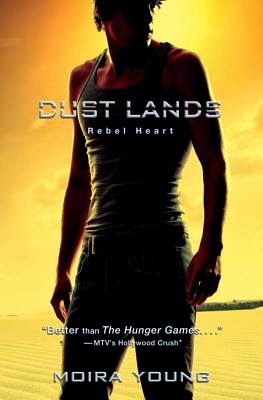
Book Review: Rebel Heart


Rebel Heart
Dust Lands Book 2
by Moira Young

Warning: this review may contain spoilers for the first book, Blood Red Road. If you haven't read Blood Red Road, I highly recommend it! It's about an incredibly tough heroine on a quest to save her brother in a post-apocalyptic wasteland. 

In Blood Red Road, Saba had one goal: find and save her twin brother Lugh from the people who took him. Saba knew that once she found Lugh, everything would be all right. But everything is most definitely not all right. Lugh and Saba have both been changed by the traumatic things they experienced, and the bond that connected them their whole lives seems to be broken and unrepairable.

Saba and Lugh, along with younger sister Emmi and another young man, Tommo, are on their way west to start a new life. Jack, whom Saba recently discovered is her heart's desire, separated from them to take a hard journey to deliver bad news, but he promised to meet them in the west. Saba is desperate to go west and find Jack again, but the group is stuck in the Waste, waiting for an injured horse to heal.

Then word comes that the Tonton, so recently defeated by Saba and her friends, have a new leader, who is cleansing the land of everyone except his own followers, killing or driving out the weak and the old, and taking the young and healthy. What's worse, Jack has been seen with the Tonton and may be one of them. Saba can't believe that Jack would be a part of such horrors, and she's determined to go back and find the truth, and help if she can.

Like Blood Red Road, Rebel Heart is a roller coaster of a story that grabs you and won't let go. Saba is one of the best YA heroines I've ever read. She's tough, oh yes, she's tough, but she also has heart and depth and an unshakeable resolve. Saba is a flawed heroine. She makes mistakes, she's not always kind, and she sometimes lets her single mindedness blind her. But Saba is a person who cares deeply, and would do anything for her family and her friends.

As with the first book, Rebel Heart is told in first person in Saba's distinctive voice and dialect, which is a little difficult to read at first, but it doesn't take long to seem natural, and it's such an integral part of the book that it's hard to imagine this book without it. The entire book is also written without quotation marks. All dialog is simply written out as part of the text with nothing to set it off. This also seems odd at first, but you get used to it and don't notice it. The biggest effect, to me, is that with the breakneck pace of the novel, the lack of quotation marks to slow the eye down contributes to a feeling of going downhill without brakes.

Overall, Rebel Heart and its predecessor, Blood Red Road, are excellent books that will have strong appeal to anyone who enjoys dystopian YA literature. Although more post-apocalyptic than dystopian, there are some dystopian elements in the Tonton society ruled by their new charismatic leader, the Pathfinder, and the book has a dystopian feel to it.

Rebel Heart ends on a bit of a cliffhanger, and the third book, Raging Star, is due out May 13. I can't wait to read it!

Who would like this book:

Anyone who enjoys young adult dystopian books and who doesn't mind the unusual punctuation and dialect.

Rebel Heart is a 2013 Cybils Awards Nominee. The first book, Blood Red Road, was the 2011 Cybils winner for YA Science Fiction & Fantasy.

Get it from:
Audiobook:

Rebel Heart is available as an audiobook from Audible.com. I haven't yet listened to the audiobook, but I did listen to the audiobook for Blood Red Road and thought it was very well done. Narrator Heather Lind did an excellent job. There appears to also be a version narrated by Moira Young, but Audible tells me it isn't available in my area, so I suspect it's the Canadian version. The links below are to the Heather Lind narrated version.
FTC required disclosure: Reviewed from purchased copy. The bookstore links above are affiliate links, and I earn a very small percentage of any sales made through the links. Neither of these things influenced my review.
Monday, February 17, 2014

Book Review: The Summer Prince

The Summer Prince
by Alaya Dawn Johnson

June and her best friend Gil are thrilled to wrangle an invite to the official celebration of the newly elected Summer King, Enki. But they never anticipate that Gil and Enki will fall in love, or how much Enki will affect both of their lives. Although the Summer King has no real power, Enki, who comes from the lowest level of society, is determined to use what influence he has to help his people. June and Enki begin to collaborate on a big art installation, one that they hope will both send a message to the city, and win June the Queen's Award. But none of the three can forget that at the end of the summer, Enki will die. Because the real purpose of the Summer King is sacrifice in service of the city.

The Summer Prince is a brilliant book on so many levels. To start, it's an achingly immersive story set in a future Brazil. Added to that are elements from the Sumerian myth The Epic of Gilgamesh. Going deeper, there are the themes: power and sacrifice, choices and consequences, privilege and class, order and change. Finally, there is the writing: Alaya Dawn Johnson has created a beautiful tapestry so intricately woven that the patterns aren't always obvious on the first read-through. Even on my second read I'm not sure if I saw everything.

Palmares Tres is a gem of a city where past culture and future culture merge. It's a city where people still Samba and eat Vatapá stew, where grafeteiros create masterpieces and street gangs fight with capoeira. And yet it's a city with deep class divisions, where class hierarchy is literally expressed in the city tiers: the higher classes live on the upper levels and the lowest class lives on the bottom tier, where the the stink of the algae vats is ever present. This physical expression of class hierarchy is not a new idea in science fiction, but it's well done here. That stink, known as the Catinga, becomes a powerful symbol in the story, and in fact the higher tiers call the lowest tier "The Catinga."

Palmeres Tres is a city ruled by a matriarchy: a Queen and a council of women called Aunties. Many of them have forgotten the purpose of power, and while they, in their own way, seem to love the city, often their machinations seem designed to protect their own power rather than benefit the city. Most residents of the city live 200 years or more, setting up a situation where anyone under 30 is considered a juvenile, and not to be trusted to make good decisions. So we have class conflict, gender conflict, and age conflict, and with his election as Summer King, Enki becomes the touchstone at the center of all these conflicts.

I've seen this book described as dystopian, but I don't think that it quite falls into that classification. The traditional definition of a dystopia is one that seems utopian on the surface, but is later revealed to be oppressive and deeply flawed. I think that in some ways The Summer Prince turns that around: the flaws are fairly obvious early on, but as you continue to read it becomes clear how much the citizens of Palmeros Tres love their city with a genuine love, even in spite of the flaws. However, The Summer Prince is similar enough to dystopian literature that I think it will appeal to teens who enjoy dystopian books.

It's not necessary to be familiar with The Epic of Gilgamesh or to even recognize those elements are there to enjoy the story, but if you are familiar with the Epic it's a sheer joy to discover the iconic story of Enkidu and Gilgamesh wrestling in the streets transformed into a heart-stopping Samba when Gil and Enki first meet. The Summer Prince is not really a retelling of the myth, but there are some interesting parallels.

June is an imperfect character who struggles throughout the book to make the right choices. Her dream is to be recognized as a great artist, and when that dream comes into conflict with her awakening social awareness, she doesn't always choose the right thing. She blames her mother for her father's death, and because of that she's mean to her mother. All these things make her a believable, realistic character whom the reader can identify with as she grows through her association with Enki.

The Summer Prince does a great job of representing people who are underrepresented in YA lit. All the residents of Palmeros Tres have skin of varying shades of color, and Enki himself is described as being exceptionally charismatic and with very dark skin. Sexual relationships, both same-sex and opposite-sex, are depicted in a natural, unfettered way that's totally a non-issue. In Palmeros Tres it doesn't seem to matter whom you love.

The Brazilian setting is a refreshing change from books set in European-based settings. I personally loved that the book represented a culture and people that you don't often see in American YA Fiction, but I'd be remiss if I didn't point out this review of The Summer Prince by a native Brazilian, Ana of The Book Smugglers. I'd encourage you to read the review, but in short, Ana is concerned that the Brazilian cultural elements are not always used accurately, and don't go any deeper than those elements that outsiders identify with Brazil, such as samba, Carnival, and capoeira. To Ana, it feels like a stereotype.

I've been thinking a lot about Ana's review over the last few days. Does the book stereotype Brazilians? Maybe - it's hard for me to know since I'm not Brazilian. Should a writer be able to write about a culture as an outsider to that culture? This, I think, is the crux of the controversy, and I've seen good arguments on both sides. I personally think writers stretching to write about things outside their personal experience is a good thing, because it helps to bring those ideas and cultures to other people who are not familiar with them, but the outsider has to work harder to get it right. I found an interview with Johnson where she says about her research, "I read a lot of books, particularly about the history of the African diaspora in Brazil. Also got advice from my sister, who studied in Brazil and knew many sources. And sent it to Brazilian writers for help."

I totally understand Ana's frustration and annoyance with the book. It's not quite the same thing, but I studied a martial art for 18 years, and I get really annoyed when I read a fiction book that gets the martial arts details wrong. So I get how frustrating it would be to have your culture portrayed inaccurately. But it does sound like Johnson did try get the details right, and I hope that maybe it will at least it will inspire young people to want to learn more about Brazil and read up on it, as I did after finishing the book. In balance, I think that a book like this that encourages young people to think outside their comfort zone and learn about new ideas and new cultures is a good thing. There are no easy answers, but I think it's important that we keep having these conversations as we try to get it right.

The Summer Prince is the 2013 Cybils Awards winner for the YA Speculative Fiction category.

Who would like this book:

Science fiction and dystopian readers, as well as teens who like reading about other cultures.

Get it from:
Audiobook:


FTC required disclosure: Review copy sent by the publisher for the purpose of Cybils Awards judging. The bookstore links above are affiliate links, and I earn a very small percentage of any sales made through the links. Neither of these things influenced my review.

Monday, January 13, 2014

Book Review: Shadows


 Shadows

by Robin McKinley

It's not just that Maggie misses her father, or understandably resents her new stepfather, Val. No, it goes beyond that: Val has too many shadows. Whenever Maggie looks at him, she sees him surrounded by wiggly shadow shapes with too many appendages. It can't be magic, because there is no magic in Newworld. Anyone with the potential for magic must have a procedure to snip the gene before they reach puberty, and even though Val is an immigrant, he wouldn't have been allowed in if he had any magic.

Maggie tries not to think about it, and avoids Val as much as possible by throwing herself into her work at the local animal shelter, which isn't hard, since Maggie loves animals anyway. Then a cobey — a "coherence break" in the universe — opens nearby, and with one revelation after another, Maggie begins to discover that the world — and Newworld specifically — is full of surprises, among them that Val is not such a bad guy. When the situation goes from bad to worse, Maggie and her friends set out to set things right, accompanied by five very large dogs, a cantankerous Maine Coone cat, a friendly shadow named Hix, and one stubborn algebra book.

Shadows is a fun book with loads of teen appeal. Maggie's voice as the narrator is authentic and entertaining, if a bit rambly in parts, and there's gentle humor woven throughout the book. The pacing is excellent, perfectly balancing character development, excitement, humor, and reveals. All of the characters are interesting and well-developed, including animals, shadows, and semi-animate objects. Even the dogs each have distinctive personalities. Although Maggie finds she has some unusual abilities, she can't do it alone - it takes the combined efforts and abilities of everyone to succeed. There is romance, but it's not overdone and I like the direction that McKinley went with the it.

There are dystopian elements, such as soldiers in the streets with scanners, roadblocks, and forced genetic manipulation, but I wouldn't call this a dystopian book. The focus is not on fighting against a dystopian government, although there is certainly some of that. Instead, it's more about finding yourself and discovering that the world is a different place than you thought.

Shadows is a 2013 Cybils Awards Finalist in the YA Speculative Fiction category.

Who would like this book:

Readers of both traditional fantasy and dystopian stories will enjoy this, as it has elements of both. Dog lovers, cat lovers, and origami artists will also find a lot to appreciate.

Get it from:
FTC required disclosure: Reviewed from library copy. The bookstore links above are affiliate links, and I earn a very small percentage of any sales made through the links. Neither of these things influenced my review.


Wednesday, June 19, 2013

Book Review: The 5th Wave


The 5th Wave
by Rick Yancey

The 1st Wave: Lights Out

The 2nd Wave: Surf's Up
The 3rd Wave: Pestilence
The 4th Wave: Silencer

Plot: Nearly 7 billion people are dead, almost the entire population of the world, killed in four successive waves of destruction sent by the aliens. Cassie Sullivan has lost everyone she loved, all dead -- except possibly one, and to that one she made a promise that she intends to keep no matter what the cost. 


Seventeen-year-old Zombie has lost everything and everyone, too. He failed to protect his sister when she needed him, and now he has no desire to go on. Then Zombie is given a new purpose and a chance to redeem himself when he's recruited into a newly formed military unit comprised entirely of children and teens being trained to fight back against the alien invasion.

These teens, and the other few remaining survivors must make a choice. To hide. To run. Or to stand and face whatever comes. To choose to be human, even when it's the hardest choice of all.

Notes

  • The 5th Wave is a remarkable story and a remarkably well-written book. With excellent character development, rich sensory language, layers of reveals, a surprisingly sweet (and hot) romance, and some dystopian elements, it's a science fiction book that even people who don't read science fiction can enjoy. It's an unusual creature: a thrilling page turner with philosophical underpinnings. It's a book that you can read more than once and get something different out of it each time (I read it a second time immediately after finishing it, and would still like to read it a third time when I get a chance).
  • The writing is complex, with multiple point of view characters and extensive flashbacks that circle around on themselves. Different characters' experiences conflict with each other, leaving the reader (like the characters) wondering exactly what the truth is. While that's a plus for many people (it is for me), there are some readers who will find it challenging and difficult to understand.
Who would like this book:
  • Science fiction readers, dystopia fans, and anyone who likes a good YA book which is both deep and thrilling, with realistic teen characters. I think it will appeal to many teens, with the exception of readers who are easily confused by complex plots.
Get it from:
FTC required disclosure: Review copy sent by the publisher. The bookstore links above are affiliate links, and I earn a very small percentage of any sales made through the links. Neither of these things influenced my review.

Wednesday, March 03, 2010

Book Review: The Clone Codes

The Clone Codes
by Patricia C. McKissack, Frederick L. McKissack, and John McKissack

I wanted to like this book. I'm always on the lookout for good young adult science fiction, and this looked perfect: a future where clones are created as servants, with safeguards and restrictions genetically built in to make them the perfect slaves. Thirteen-year-old Leanna grows up believing that clones are less than human, until her mother is arrested for being part of the radical Liberty Bell movement that is working to prove that clones are equal and should be free.

This is the kind of thing that science fiction does so well: explore sociological themes in a subtle way that can open us up to thinking about our own society in a new way. However, this book has all the subtlety of a brick wall. From the opening scene, in which Leanna is participating through school in a virtual re-enactment of an Underground Railroad escape led by Harriet Tubman, it's clear that this book is intended to teach, both about history and about the evils of slavery. This is not science fiction; it's a lesson that's not very cleverly disguised as science fiction.

It's not even very well written, which surprised me since the authors (at least, two of the three of them) have won multiple major awards. The writing style is choppy, the story and character development simplistic, and there's an awful lot of "telling" when there should be "showing." There are multiple plot inconsistencies. Minor ones, to be sure, but it was enough to annoy me. I don't understand how such acclaimed authors could have written such a book, but when I look at their bio, apparently their other books have been non-fiction. I guess that there must be a big enough difference between non-fiction writing and fiction writing -- science fiction in particular -- that skill in one area doesn't necessarily translate into skill in the other. I did wonder whether the short sentences and simplistic plot were intended to address those with reading challenges, however the press materials that Scholastic sent don't say that, and I think even kids with reading challenges will spot the too-obvious lessons in this book.

I don't normally post a review when I can't say anything good about a book. I figure that every author pours their heart and soul into a book, and no author deserves to have their work publicly trashed. If I can't find enough good to say about a book, I usually decline to review it, which I guess makes my reviews more recommendations than reviews.

However, there were a couple of things that annoyed me enough about this book to make me want to post this. The first is the apparent assumption that science fiction is easy to write, and any writer can jump on board and write science fiction. I have spent my life reading science fiction and fantasy, starting in elementary school. I took a college lit class on science fiction. I've studied YA fantasy and science fiction pretty intensely over the last several years in my roles as both blogger and publisher focusing on the genre. And I can tell you that there's nothing easy about writing science fiction. It's probably one of the hardest genres to write well. You have to have all the literary skills required to write any fiction, but in addition you have to have believable world-building and credible science. You have to develop characters that may be very different from us, such as non-human species or genetically modified clones, and yet make it possible for the human reader to understand and identify with them. If you include sociological themes, you have to do it in a subtle, thought-provoking way, and not hit the reader over the head. Books like The Clone Codes are just disrespectful to the genre.

The other thing that annoys me is that I feel that this book wouldn't have been published if the authors hadn't been award-winning, well-known authors. If this book had come in the slush pile, an editor wouldn't have gotten past the first page. With the limited number of books being published, that this one was published means that another book, maybe more well-deserving but with an unknown author, was not.

FTC required disclosure: I received a review copy of The Clone Codes from the publisher. The Amazon.com links above are Amazon Associate links, and I earn a very small percentage of any sales made through the links. Neither of these things influenced my review.

Saturday, June 28, 2008

Thinking about two different vacation reads (Little Brother and The Adoration of Jenna Fox)

Last week I was on vacation, and I was looking for some great books to take with me to enjoy on the trip. I decided to take Little Brother, by Cory Doctorow, and The Adoration of Jenna Fox, by Mary E. Pearson. Both books have been much talked about on the blogs, and both intrigued me. (And a hat tip to Jen Robinson for the suggestions.)

Although both books are set in a near-future, dystopian America, it's hard to imagine two books more different, and it got me thinking about the differences.

Little Brother is set in San Francisco, a couple of years in the future, although it's so close to where we are today that it could as well be tomorrow. Marcus is a seventeen-year-old who knows a lot about technology and how to bend the "systems" to his own ends. Marcus likes to play Alternate Reality Games, or ARGs, which combines computer-based gaming with real world adventures seeking clues out in the city. While Marcus and his team are out searching for the next clue, San Francisco is attacked in the worst terrorist attack in the country's history. In the wrong place at the wrong time, Marcus and his friends are picked up by Homeland Security and interrogated in a secret prison for days. Three of them are eventually released, but one of Marcus' friends never returns. San Francisco has become a police state, as Homeland Security continues to crack down with ever tighter security. Marcus fights back in the only way he knows how, using his wits and technology to outsmart Homeland Security, and spark a revolution.

It's hard to know what to make of Little Brother. It breaks some of the rules of good writing, and in a literary sense, it isn't very well written. For example, there are many sections where the flow of the story is interrupted for several pages of description of things like encryption or the civil rights movement. And it's clearly a message book - something that's normally considered a big no-no for YA fiction.

And yet. In spite of all this, Little Brother is a darn good story. The plot is exciting and relevant, and Doctorow has done a great job of capturing an authentic teen voice. The long, technical asides will most likely appeal to his audience, and the message is one that will resonate with most teens. I personally couldn't put it down and loved every minute of it. I even enjoyed the technical descriptions, although I confess to being something of a geek myself, and I agree with the message. As I was reading it, I started thinking of young people that I wanted to pass this book along to. In fact, I wish that every teen in the U.S. - and every adult - would read this book.

I do have one more little quibble with the book. One of the strong themes in the book is one of youth empowerment, and yet for all that Marcus and his friends accomplish, nothing is solved until the adults get involved. Don't get me wrong; Marcus is a true hero, and his accomplishments are essential in moving towards the ultimate resolution. But the turning point of the book is clearly the moment when the adults get involved. It may be more believable, but I feel that it weakens the theme.

The Adoration of Jenna Fox is set a little further in the future, but not so far that you can't see it as a natural outgrowth of the present. Jenna Fox has just awakened from a year-long coma following a terrible accident that no one will tell her about. Jenna remembers nothing, and she tries to reclaim her past and her identity by watching videos that her parents recorded of her over the years. Jenna begins to piece together an identity for herself, as she integrates fragments of resurfaced memory with new experiences and feelings. But is the new Jenna Fox the same person as she was before the accident? And why does she increasingly get the sense that her parents aren't telling her everything. I can't say too much about this book without spoiling some of the surprises, but you'll have to trust me that there is a futuristic/dystopian element to it.

The Adoration of Jenna Fox is as literary as Little Brother isn't. It's beautifully written; poetic even. It's tightly plotted; the characters have depth, and issues of identity and scientific ethics are explored in a balanced way. And yet. I have to confess that I didn't enjoy it as much as I enjoyed Little Brother. Don't get me wrong, I did enjoy it. The Adoration of Jenna Fox is an excellent book. But I never completely got wrapped up in it the way I did with Little Brother. I think that in part this is because Jenna's lack of emotion in the beginning of the book distances you from her from the start, and although she does begin to feel emotions again, I never completely was able to cross that distance to identify with her. It's a beautiful book and I enjoyed it, but it was more of an external enjoyment, an appreciation of its literary qualities.

I'm not sure if any of this says anything about the quality of either book. It may say more about my personal preference than about the books themselves. I just found it interesting reading the books back to back and comparing their merits. Obviously these are two books that will appeal to very different audiences. (I refuse to classify books as "boy" books or "girl" books - I'm a girl and I know which one I preferred - and I don't believe in genderizing books. But the temptation is there to do just that with these books.) Both Little Brother and The Adoration of Jenna Fox are outstanding books that are well worth reading.

Little Brother has some minor sexual content at a level that would probably be appropriate for high school age and above.
Blogged with the Flock Browser

Saturday, June 07, 2008

Book Review: In the Company of Whispers

In the Company of Whispers
by Sallie Lowenstein

The year is 2047, and Zeyya lives in a tiny, roach-infested apartment with her parents. It's a horrible way to live, and not as nice as their previous home, but it's safer: Quarantine hasn't hit this area yet. Throughout the Greater East Coast Metropolis, people are taken away by the police, leaving only yellow Quarantine tape to indicate that they ever existed. Zeyya has never known anyone to return from Quarantine.

When Zeyya's parents are taken in Quarantine, Zeyya goes to live with her 98-year-old grandmother in one of the last free-standing houses in the Metropolis. Shortly after Zeyya moves in, Granna also takes in a strange young man named Jonah, who appears lost and homeless. Jonah is covered with intricate tatoos, and claims to be able to "access" the memories of his ancestors. Is Jonah telling the truth or is it a form of madness? Whether he is crazy or lying, Zeyya doesn't trust Jonah.

As the summer progresses, Granna shares memories of her childhood in Burma nearly a century before. Those memories serve as a comfort and an escape from the pain and loss, but they also begin to draw the three of them together in a shared bond. Despite his strangeness, Granna and Zeyya find theselves drawn to Jonah. The past brings them together, but will they survive long enough to have a shared future?

In the Company of Whispers is an amazing, unique, and genre-bending book. At its core is a frightening and poignant dystopian story, but it's also part memoir and part a fascinating look at another culture. The chapters are interspersed with photographs, letters, and mementos of the author's own childhood in Burma, memories which are echoed in the story in Granna's memories. There are also short excerpts of essays about Burma, Burmese poetry, and quotes from famous Burmese people. The effect is a fascinating collage of Burmese life, and rather than distract you from the story, as you might expect, it serves to draw in the reader and make the story more real. This look at Burma and the Burmese people has turned out to be tragically timely, given the recent cyclone that devastated Myanmar (Burma) which has left over 100 thousand people dead or missing, and countless others homeless.

The writing is beautiful and almost poetic; I love the way that things like colors and music are woven into the fabric of the story. The story itself is quite exciting and almost heart-stopping at times, as you experience the fear and sadness of living in a world where people can be taken away suddenly and with no warning. The disease itself is never described, and indeed no one seems to no much about it, which adds to the feeling of the randomness of it all. There is a strong theme of family running through it all, and of the past which is so much a part of who we are.

It's also a coming of age story,; Zeyya grows up quickly as she deals with the pain and worries of the summer. By the end of the summer, her teenage interests and worries from the beginning of the book seem almost trivial, and her friends seem shallow and childish.

The book itself has a quality feel to it that will appeal to book lovers. The pages are printed on coated paper, and there is a lovely brown case and matching endpapers.

In the Company of Whispers will be officially published in September, but because of the current situation in Burma, the publisher, Lion Stone Books, is accepting prepublication orders on their web site. There's also an interesting Q&A with the author  (in PDF format).

Pages: 379
Total 48-hour book challenge pages read: 880
Total 48-hour book challenge books read: 3
Total time reading and blogging: 15 hours and 40 minutes