Showing posts with label young adult fiction. Show all posts

Wednesday, August 19, 2015

Cybils Awards: Five Reasons to Apply as a Judge!


Everyone else is doing it, so I thought I'd post my five reasons why you should apply to be a Cybils Awards judge. As you would expect, there's a lot of overlap with other people's reasons, but I'll add my own spin on them, and with an emphasis on my category, Young Adult Speculative Fiction. For those who don't know what speculative fiction is, it includes fantasy, science fiction, horror, dystopian, steampunk, and basically anything else with supernatural, fantastical, or futuristic elements.

1. Read and discuss good books. Hopefully you don't need an excuse to read, but it doesn't hurt to be able to say, "Sorry, I can't do the dishes, I have to finish this Cybils book." Cybils judges engage in intense reading - and for Round 1, a LOT of reading - and intense discussions with a small group of people who share your book passion.

In YA Spec Fic, we've sometimes had upwards of 200 nominated books in Round 1, and while you don't have to read them all, Round 1 judges in YA SF can expect to have to read at least 40 books over a 3 month period. (Presumably, you'll already have read some of the category nominations). It's crazy intense, but so much fun! Round 2 judges have to read 5 to 7 books in a little under 6 weeks, but they get to read "the best of the best" and choose a winner.

2. Make lifelong friends. Those intense discussions with like-minded people? Turns out they're a great basis for a friendship. I've made lifelong friends from serving together on a Cybils panel. (And KidLitCon is a great place to meet up with them in person!)

3. Influence the books available for children/teen reading. Yup, awards do have an influence. And while the Cybils don't get as much media as, say, the ALA awards, we have a pretty big and dedicated following that includes teachers, librarians, and booksellers. The books you choose may end up on reading lists, getting purchased by a library, or in bookstore displays. Books that win awards and get that attention may be more likely to be reprinted or have a sequel or other books by the author published.

4. Get your blog better known. Did I mention we have a following? Round 1 judges are encouraged to blog about the books you read, and while Round 2 judges can't blog the finalists during the round, they can post reviews after the winners are announced. Throughout the Cybils season, we post review excerpts with links to reviews by both Round 1 and Round 2 judges to the Cybils blog, thus further aiding discovery of judges' blogs. During the summer, you can contribute themed book lists for posting on the Cybils blog. Being a Cybils judge can bring greater visibility to your blog, increase your traffic, and give you greater credibility with publishers.

5. Learn a lot. I mean, a lot. I sometimes think I know a lot about YA SF, but every year I'm blown away by the knowledge and expertise of my fellow judges, and every year I learn more from them.

What I'm looking for

As Category Chair for YA Speculative Fiction, I have the responsibility to choose the judges for my category. It's my least favorite part of the Cybils: I hate having to choose one person over another, but unfortunately we usually don't have room for everyone.

Here are some of the things that I look for:

1. A passion for speculative fiction. If your "about" on your blog says that you don't really like most spec fic, then I'll most likely pass. If you don't post about SF much, I'll think long and hard before choosing you.

2. Knowledge of spec fiction and its subgenres. Speculative Fiction is a very diverse genre. One day you might be reading a scary ghost story, and the next a futuristic dystopian. I look for people who have read broadly within the genre and can discuss the various aspects, literary elements, and tropes of the genre.

3. Critical thinking skills. I have to know that you can think critically about books and analyze the literary elements and readability of a book. Reviews are a great way to demonstrate this, but if you don't review books, hopefully you can submit other blog posts that demonstrate your critical thinking skills.

4. Open to diverse perspectives. I want to see that you have a demonstrated interest in diversity, and a tolerance for worldviews different from your own.

5. Diverse backgrounds. I mean this in two ways. First, I look for people who can bring expertise or experience with one or more under-represented groups, in what we usually mean when we say diversity. For example, do you blog about people of color, LGBTQA+ characters, differently-abled characters, different religious or worldviews, etc.? Second, I look for a variety of personal and work experience, so that the panel is hopefully made up of a good mix of librarians, teachers, parents, booksellers, authors, etc.

So I have I scared you off yet? Oops, I was supposed to be convincing you why you should apply! Please do apply, and if YA Speculative Fiction isn't your thing, we have plenty of other categories ranging from Easy Readers to Young Adult. We even have a book apps category!

Here's the information on how to apply!

Also, see the following posts for more reasons to apply!


Tuesday, May 05, 2015

Book Review: An Ember in the Ashes

An Ember in the Ashes

by Sabaa Tahir

Told in alternating stories of two main characters on opposite sides, An Ember in the Ashes is a suspenseful exploration of the effects of violence on both the conquered and the conquerors. Set in a Rome-like fantasy world, the Scholars are a subjugated people under the rule of the Martials. Laia is a Scholar living with her brother and grandparents. When her brother is arrested on suspicion of being a member of the resistance, and her grandparents are killed violently by Martial soldiers, Laia runs away in fear. To atone for her cowardice, Laia sets out to save her brother, and goes undercover as a slave to the cruel and sadistic commander of the elite military academy Blackcliff.

Elias is a student at Blackcliff, training to become a Mask, the most elite of Martial soldiers. Although he has lived most of his life as a student under the harsh discipline at Blackcliff, Elias still sees things differently than his peers because he spent the first six years of his life outside the Martial society. Elias is determined to escape the violent society and his role as an enforcer as soon as he graduates. Then a visit from the Augurs — the Martial's version of oracles — puts a difficult choice before Elias. But can he trust the prophecy, or is he being manipulated by the Augurs?

Sabaa Tahir was inspired to write An Ember in the Ashes during her time at the Washington Post's foreign desk, when she was exposed to horrifying stories of the effects of violence on people around the world. An Ember in the Ashes is an exciting dystopian story that shows how a violent society affects everyone, from the slaves to the highest levels. Even the resistance is divided by the question of whether they have an obligation to help those of their people in need, or whether such aid detracts from their mission of fighting back against the Martials.

I had some minor credibility problems, and the plot development was occasionally awkward. I thought that the addition of supernatural characters like djinn was an unnecessary device that muddies the waters. The augurs were fine and really drive the plot in many ways, but the djinn and other spirits made it start to feel like everything was thrown in, including the kitchen sink.

This isn't a subtle book: the message about the effects of violence is hammered pretty hard. However, as I write this in a Baltimore (and a nation) trying to figure out how to police our communities without unnecessary violence by police against the people they are supposed to protect, the message really resonates.

In spite of the minor issues, I found An Ember in the Ashes to be a thrilling and highly engaging plot-driven story with loads of teen appeal, especially for fans of dystopian fiction like the Hunger Games. I can understand why it's been optioned for film already.

Diversity

Elias is described as having golden-brown skin. The identity of Elias' father is unknown, but it's likely that his skin color came from his father, since his mother is described as having pale skin. Other than that, skin color doesn't seem to play a role, although one of the more despicable characters is also described as having dark skin. The Martial empire appears to be generally diverse, with various ethnicities of people coming from the different conquered nations, although it's not significant to the plot.

Although the empire appears to be fairly patriarchal, female characters play a significant role. Besides Laia, there's Helene, who is also a student at Blackcliff and Elias' best friend. Helen is one tough cookie, in some ways one of the toughest students there. In spite of that, though, she's mostly relegated to the traditional female support role, and a subplot about an attraction leaves her acting "like a girl." There's also the female commander of Blackcliff, and several minor female characters including a cook who used to be an explosives expert.

The author is a woman of color.


Who would like this book?

Anyone who enjoys a thrilling, suspenseful plot-driven story, particularly fans of The Hunger Games and other dystopian fiction. In keeping with the theme, An Ember in the Ashes is fairly dark and violent, so sensitive readers may want to take a pass.


Buy from Powells.com:


FTC required disclosure: Review copy sent by the publisher to enable me to write this review. The bookstore links above are affiliate links, and I earn a very small percentage of any sales made through the links. Neither of these things influenced my review.

Thursday, May 08, 2014

Book Review: In the Shadows


In the Shadows
Text Story by Kiersten White
Art and Art Story by Jim Di Bartolo

In the Shadows alternates between two related stories, one told in text and the other entirely in pictures. It's hard to talk about In the Shadows without risking revealing too much. The stories themselves unfold gradually, and at first it's hard to understand what's going on or how the stories fit together, but as the details unfold the pieces start to come together.

The text portion alternates between five young people: Cora and Minnie, whose mother runs a boarding house in a small town in Maine; Arthur, a mysterious young man who comes to the boarding house; and two brothers, Thom and Charles. Charles is dying from a terminal illness, and their father sends the two young men from New York City to Maine for Charles' health, although a conversation that Thom overhears between his father and a woman seems to indicate a more sinister reason. The five teens begin to suspect that there is evil lurking in the town, and all five of them are linked to it in some way.

The art story depicts a young man traveling around the world, apparently searching for something or someone. We don't know who he is, and at first it's hard to understand what's going on or what the connection is with the text story. By about halfway through, you begin to suspect, and then later details in the text story make clear what's happening in the art story.

In the Shadows is an intriguing, beautifully made book. I love this kind of story, where the connections aren't always clear and you have to puzzle it out as you go along. I actually found that after I finished the book, I wanted to go through the art story again from the beginning to pick up on all the details and fully appreciate it.

The text story is well-written and holds your interest, the art is beautiful, and the two fit well together stylistically. There is a dark, creepy, and mysterious feel to both stories. With evil lurking in a small town in Maine, it's hard not to compare this to Stephen King, but stylistically it's not really similar to King's writing. The compelling story and short chapters conspire to keep you reading; "Just one more chapter," I kept telling myself.

Diversity?

Other than a few incidental characters in the pictures, I didn't see any diversity.

Who would like this book:

With the short chapters, artwork, and fast-paced read, this may be a good book for reluctant readers. Graphic novel readers may also enjoy it, even though it isn't strictly a graphic novel. Any teen or adult who enjoys dark, creepy stories with mysterious conspiracies will enjoy In the Shadows.

Get it from:
FTC required disclosure: Review copy sent by the publisher to enable me to write this review. The bookstore links above are affiliate links, and I earn a very small percentage of any sales made through the links. Neither of these things influenced my review.

Tuesday, April 01, 2014

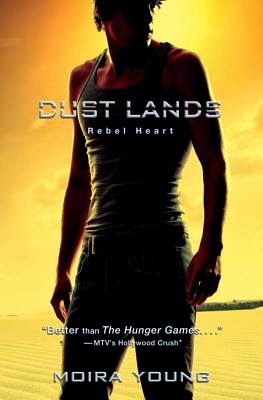
Book Review: Rebel Heart


Rebel Heart
Dust Lands Book 2
by Moira Young

Warning: this review may contain spoilers for the first book, Blood Red Road. If you haven't read Blood Red Road, I highly recommend it! It's about an incredibly tough heroine on a quest to save her brother in a post-apocalyptic wasteland. 

In Blood Red Road, Saba had one goal: find and save her twin brother Lugh from the people who took him. Saba knew that once she found Lugh, everything would be all right. But everything is most definitely not all right. Lugh and Saba have both been changed by the traumatic things they experienced, and the bond that connected them their whole lives seems to be broken and unrepairable.

Saba and Lugh, along with younger sister Emmi and another young man, Tommo, are on their way west to start a new life. Jack, whom Saba recently discovered is her heart's desire, separated from them to take a hard journey to deliver bad news, but he promised to meet them in the west. Saba is desperate to go west and find Jack again, but the group is stuck in the Waste, waiting for an injured horse to heal.

Then word comes that the Tonton, so recently defeated by Saba and her friends, have a new leader, who is cleansing the land of everyone except his own followers, killing or driving out the weak and the old, and taking the young and healthy. What's worse, Jack has been seen with the Tonton and may be one of them. Saba can't believe that Jack would be a part of such horrors, and she's determined to go back and find the truth, and help if she can.

Like Blood Red Road, Rebel Heart is a roller coaster of a story that grabs you and won't let go. Saba is one of the best YA heroines I've ever read. She's tough, oh yes, she's tough, but she also has heart and depth and an unshakeable resolve. Saba is a flawed heroine. She makes mistakes, she's not always kind, and she sometimes lets her single mindedness blind her. But Saba is a person who cares deeply, and would do anything for her family and her friends.

As with the first book, Rebel Heart is told in first person in Saba's distinctive voice and dialect, which is a little difficult to read at first, but it doesn't take long to seem natural, and it's such an integral part of the book that it's hard to imagine this book without it. The entire book is also written without quotation marks. All dialog is simply written out as part of the text with nothing to set it off. This also seems odd at first, but you get used to it and don't notice it. The biggest effect, to me, is that with the breakneck pace of the novel, the lack of quotation marks to slow the eye down contributes to a feeling of going downhill without brakes.

Overall, Rebel Heart and its predecessor, Blood Red Road, are excellent books that will have strong appeal to anyone who enjoys dystopian YA literature. Although more post-apocalyptic than dystopian, there are some dystopian elements in the Tonton society ruled by their new charismatic leader, the Pathfinder, and the book has a dystopian feel to it.

Rebel Heart ends on a bit of a cliffhanger, and the third book, Raging Star, is due out May 13. I can't wait to read it!

Who would like this book:

Anyone who enjoys young adult dystopian books and who doesn't mind the unusual punctuation and dialect.

Rebel Heart is a 2013 Cybils Awards Nominee. The first book, Blood Red Road, was the 2011 Cybils winner for YA Science Fiction & Fantasy.

Get it from:
Audiobook:

Rebel Heart is available as an audiobook from Audible.com. I haven't yet listened to the audiobook, but I did listen to the audiobook for Blood Red Road and thought it was very well done. Narrator Heather Lind did an excellent job. There appears to also be a version narrated by Moira Young, but Audible tells me it isn't available in my area, so I suspect it's the Canadian version. The links below are to the Heather Lind narrated version.
FTC required disclosure: Reviewed from purchased copy. The bookstore links above are affiliate links, and I earn a very small percentage of any sales made through the links. Neither of these things influenced my review.

Monday, March 24, 2014

Book Review: Underneath

Underneath

by Sarah Jamila Stevenson

Sunny Pryce-Shah is devastated when her cousin Shiri commits suicide. How could Shiri do it? Shiri always seemed so confident, and Sunny looked up to her older cousin. Then Sunny starts to hear thoughts, and from cryptic comments in Shiri's journal, she suspects that Shiri may have had the same problem. Hearing thoughts is more of a curse than a power. It can be painful to know what people really think of you, for example, and Sunny can't control it or stop it from happening. Sunny is already dealing with so much, but she knows that she has to get the ability under some kind of control before it pulls her apart like it did her cousin.

Underneath is a contemporary YA novel with a speculative twist. The underhearing is just one of the conflicts Sunny has to deal with. In addition to grief over her cousin and dealing with her unusual problem, Sunny also has to navigate the treacherous waters of the high school social scene, and her family is dealing with the possible spousal abuse of her aunt. The relationships, including family, friend, and romantic interest, feel authentic, and I like that the book portrays how complex such relationships are. Fights happen, and sometimes no one is right or wrong and you just have to find a way to work things out. But sometimes one person's behavior is wrong, and it's not always easy to tell the difference.

The book also portrays grief in a way that seems authentic. Grief doesn't just go away because a certain amount of time has passed, and one of the difficult things for someone bereaved is when people start to feel that they should be over it. Grief also takes different forms, and different people grieve in different ways at different times.

I also like that romance isn't a major focus of the story. There are romantic interests, and even a couple of love triangles, but in the end it's not important who ends up paired with whom, and the story is really much more about friendship (and family) than romance.

From a diversity perspective, Sunny is half Pakistani. Although she is pretty much a regular American teenager, there are some bits of Pakistani culture that come from her grandparents, for example when they send over Pakistani food, or request an imam at the funeral. It's handled very naturally as a part of the normal American experience and not at all an issue.

In the end, it's character and voice that make this a compelling novel. Sunny is such an interesting character with a distinctive voice, and we feel her pain and her struggles.

The underhearing itself is never explained, and this may bother some readers. However, not understanding it is a part of the story conflict, and in real life there isn't always a neat explanation that ties things up with a bow.  I do love the word "underhearing" - it's a perfect word for what is, in essence, mental overhearing.

Who would like this book:

Teens who enjoy contemporary fiction with a paranormal twist.

Underneath is a 2013 Cybils Awards Nominee

Get it from:
FTC required disclosure: Reviewed from library copy. The author is an online friend that I've met several times at conferences. The bookstore links above are affiliate links, and I earn a very small percentage of any sales made through the links. Neither of these things influenced my review.

Friday, March 21, 2014

The Infinite Sea Cover Reveal


The cover for The Infinite Sea, sequel to Rick Yancey's The 5th Wave, has been revealed. You can see a larger image of it over at USA Today, along with an interesting interview with Rick Yancey. (Note: Although Yancey tries to be careful not to spoil anything, I think it does give some clues about the second book).

The 5th Wave was an excellent book about the aftermath of an alien invasion, although one of the themes of the book is that this alien invasion is not a anything like what you would expect from movies and TV. ("...not-your-grandma's alien invasion," as Yancey says in the interview). You can read my review of The 5th Wave here.

I'm really looking forward to reading The Infinite Sea, which will be published September 16. I'm particularly excited that Yancey mentions in the interview that there are still some plot twists, as one of the things I loved about the first book was the layers of surprising reveals.

Also, Yancey talks about the 5th Wave movie in the interview, and it sounds like that's making progress.

Tuesday, March 18, 2014

Light of the White Bear Kickstarter Project


David Clement-Davies, author of The Sight, Fell, and Fire Bringer, is running a Kickstarter project to bring his newest book, Light of the White Bear, to the United States. I've read several of his books and really enjoyed them. If you like books about wild animals, with deep social and spiritual themes, you'll enjoy his books.

If you'd like to support an author fighting for autonomy over his books, or if you just like his books (or think you might!) please consider backing this Kickstarter.
https://www.kickstarter.com/projects/1159695087/light-of-the-white-bear

Monday, February 17, 2014

Book Review: The Summer Prince

The Summer Prince
by Alaya Dawn Johnson

June and her best friend Gil are thrilled to wrangle an invite to the official celebration of the newly elected Summer King, Enki. But they never anticipate that Gil and Enki will fall in love, or how much Enki will affect both of their lives. Although the Summer King has no real power, Enki, who comes from the lowest level of society, is determined to use what influence he has to help his people. June and Enki begin to collaborate on a big art installation, one that they hope will both send a message to the city, and win June the Queen's Award. But none of the three can forget that at the end of the summer, Enki will die. Because the real purpose of the Summer King is sacrifice in service of the city.

The Summer Prince is a brilliant book on so many levels. To start, it's an achingly immersive story set in a future Brazil. Added to that are elements from the Sumerian myth The Epic of Gilgamesh. Going deeper, there are the themes: power and sacrifice, choices and consequences, privilege and class, order and change. Finally, there is the writing: Alaya Dawn Johnson has created a beautiful tapestry so intricately woven that the patterns aren't always obvious on the first read-through. Even on my second read I'm not sure if I saw everything.

Palmares Tres is a gem of a city where past culture and future culture merge. It's a city where people still Samba and eat Vatapá stew, where grafeteiros create masterpieces and street gangs fight with capoeira. And yet it's a city with deep class divisions, where class hierarchy is literally expressed in the city tiers: the higher classes live on the upper levels and the lowest class lives on the bottom tier, where the the stink of the algae vats is ever present. This physical expression of class hierarchy is not a new idea in science fiction, but it's well done here. That stink, known as the Catinga, becomes a powerful symbol in the story, and in fact the higher tiers call the lowest tier "The Catinga."

Palmeres Tres is a city ruled by a matriarchy: a Queen and a council of women called Aunties. Many of them have forgotten the purpose of power, and while they, in their own way, seem to love the city, often their machinations seem designed to protect their own power rather than benefit the city. Most residents of the city live 200 years or more, setting up a situation where anyone under 30 is considered a juvenile, and not to be trusted to make good decisions. So we have class conflict, gender conflict, and age conflict, and with his election as Summer King, Enki becomes the touchstone at the center of all these conflicts.

I've seen this book described as dystopian, but I don't think that it quite falls into that classification. The traditional definition of a dystopia is one that seems utopian on the surface, but is later revealed to be oppressive and deeply flawed. I think that in some ways The Summer Prince turns that around: the flaws are fairly obvious early on, but as you continue to read it becomes clear how much the citizens of Palmeros Tres love their city with a genuine love, even in spite of the flaws. However, The Summer Prince is similar enough to dystopian literature that I think it will appeal to teens who enjoy dystopian books.

It's not necessary to be familiar with The Epic of Gilgamesh or to even recognize those elements are there to enjoy the story, but if you are familiar with the Epic it's a sheer joy to discover the iconic story of Enkidu and Gilgamesh wrestling in the streets transformed into a heart-stopping Samba when Gil and Enki first meet. The Summer Prince is not really a retelling of the myth, but there are some interesting parallels.

June is an imperfect character who struggles throughout the book to make the right choices. Her dream is to be recognized as a great artist, and when that dream comes into conflict with her awakening social awareness, she doesn't always choose the right thing. She blames her mother for her father's death, and because of that she's mean to her mother. All these things make her a believable, realistic character whom the reader can identify with as she grows through her association with Enki.

The Summer Prince does a great job of representing people who are underrepresented in YA lit. All the residents of Palmeros Tres have skin of varying shades of color, and Enki himself is described as being exceptionally charismatic and with very dark skin. Sexual relationships, both same-sex and opposite-sex, are depicted in a natural, unfettered way that's totally a non-issue. In Palmeros Tres it doesn't seem to matter whom you love.

The Brazilian setting is a refreshing change from books set in European-based settings. I personally loved that the book represented a culture and people that you don't often see in American YA Fiction, but I'd be remiss if I didn't point out this review of The Summer Prince by a native Brazilian, Ana of The Book Smugglers. I'd encourage you to read the review, but in short, Ana is concerned that the Brazilian cultural elements are not always used accurately, and don't go any deeper than those elements that outsiders identify with Brazil, such as samba, Carnival, and capoeira. To Ana, it feels like a stereotype.

I've been thinking a lot about Ana's review over the last few days. Does the book stereotype Brazilians? Maybe - it's hard for me to know since I'm not Brazilian. Should a writer be able to write about a culture as an outsider to that culture? This, I think, is the crux of the controversy, and I've seen good arguments on both sides. I personally think writers stretching to write about things outside their personal experience is a good thing, because it helps to bring those ideas and cultures to other people who are not familiar with them, but the outsider has to work harder to get it right. I found an interview with Johnson where she says about her research, "I read a lot of books, particularly about the history of the African diaspora in Brazil. Also got advice from my sister, who studied in Brazil and knew many sources. And sent it to Brazilian writers for help."

I totally understand Ana's frustration and annoyance with the book. It's not quite the same thing, but I studied a martial art for 18 years, and I get really annoyed when I read a fiction book that gets the martial arts details wrong. So I get how frustrating it would be to have your culture portrayed inaccurately. But it does sound like Johnson did try get the details right, and I hope that maybe it will at least it will inspire young people to want to learn more about Brazil and read up on it, as I did after finishing the book. In balance, I think that a book like this that encourages young people to think outside their comfort zone and learn about new ideas and new cultures is a good thing. There are no easy answers, but I think it's important that we keep having these conversations as we try to get it right.

The Summer Prince is the 2013 Cybils Awards winner for the YA Speculative Fiction category.

Who would like this book:

Science fiction and dystopian readers, as well as teens who like reading about other cultures.

Get it from:
Audiobook:


FTC required disclosure: Review copy sent by the publisher for the purpose of Cybils Awards judging. The bookstore links above are affiliate links, and I earn a very small percentage of any sales made through the links. Neither of these things influenced my review.

Thursday, February 06, 2014

Book Review: The Archived

The Archived
by Victoria Schwab

It hasn't even been a year since Ben died, and Mackenzie Bishop is already forgetting what her brother looked like. Her mother copes with the grief by throwing herself with artificial cheerfulness into projects, while her father copes by retreating into himself.

Mac knows something her parents don't: that all the memories of the dead are archived as Histories, which look and act like the living person in every way. Histories usually sleep, but sometimes one awakens and tries to get out; occasionally they're even violent. Mac is a Keeper, tasked with guarding the Narrows that border the Archive and returning any of the Histories who escape. It's a role that she inherited from her grandfather, and one that she must keep absolutely secret, even from her parents. Knowing that Ben's History is in the Archive should be a comfort to Mac, but even a Keeper can't see the Histories, and Mac fears that she is losing her memories of Ben.

When Mac's family moves into the Coronado, an old hotel converted to an apartment building, Mackenzie gets a new territory in the Narrows to patrol. But something is not right — the Histories here are restless, and Mac is busier than ever trying to return them all. What's more, it appears that a murder was committed decades ago at the Coronado, a murder that someone went to a great deal of trouble to cover up. Mac is determined to find out the truth, even if it means putting her life at risk.

The Archived is a moving exploration of life, death, and grief wrapped up in an intriguing, character-driven mystery. Mac is tough — she has to be, to deal with the sometimes violent Histories — and she has the scars to prove it. But even her toughness doesn't make her immune to grief, and like everyone else she'll need to find a way to deal with it and move towards acceptance.

The story has a strong sense of place, and the various locations are lovingly described: the elegant, library-like atmosphere of the Archives, the creepy hallways of the Narrows, and the faded glory of the Coronado, which really becomes a character in its own right. The characters are likewise vividly brought to life. Besides Mac, there is a teen boy, Wes, that she meets in the Coronado. Wes hides a surprising depth and empathy behind a façade of good-natured humor. Mac's relationship with her grandfather is developed through flashbacks. Other minor characters, such as the Librarians in the Archives, are less fully-fleshed-out, but still distinctively characterized.

The setup with the Archives is intriguing and pleasingly unique. The internal logic is pretty consistent and well-developed, with one exception that bothered me. What is the purpose of keeping the Archives in the first place? There doesn't seem to be any reason for it. Loved ones can't visit the Histories, and no one seems to read the Histories except for the occasional Librarian seeking relief from boredom, and even that seems to be discouraged. It seems like an elaborate setup requiring considerable secrecy and no small amount of risk, for no purpose. If you can suspend that disbelief, then The Archived is a pretty enjoyable book.

The Archived is a 2013 Cybils Awards Nominee

Who would like this book:

Although the setup is not strictly supernatural — Histories aren't really ghosts — it should appeal strongly to fans of supernatural fiction. Teens who enjoy mysteries or character-driven fiction may also enjoy this.

Get it from:
FTC required disclosure: Reviewed from library copy. The bookstore links above are affiliate links, and I earn a very small percentage of any sales made through the links. Neither of these things influenced my review.


Monday, August 19, 2013

Book Review: The Color of Rain

The Color of Rain
by Cori McCarthy

Plot: Rain White lives in Earth City, where she ekes out a living trying to take care of her little brother, Walker. That is, until Walker becomes one of the Touched, people who have a degenerative brain disease. If the authorities find out about Walker, they'll take him away. No one knows what happens to the Touched after the authorities take them, and Walker is the only family that Rain has left.

Determined to protect her brother, Rain makes a deal with an offworlder, Johnny, who promises Rain and Walker passage through space to the Edge, where the bioengineered Mecs may be able to cure Walker. In exchange for passage, Rain agrees to be Johnny's girl. But Rain has no idea what she's getting into. Onboard ship, Rain learns that Johnny has many girls, and runs a prostitution ring. But Johnny has even darker secrets than that, and soon Rain must make a choice whether to get involved for the greater good, or to continue to do whatever it takes to ensure that she and Walker survive and make it to the Edge.


Notable Characters:
  • Rain White. Tough girls are becoming more common in YA fiction, but very few of them are as tough as Rain. Rain lives through forced prostitution and psychological and physical torture, yet she survives. More than that, Rain manages to keep her essential self intact, and even to help others when she can.
  • Johnny. The mysterious ship captain who makes a deal with Rain to take her and Walker off-planet. About the nicest thing you can say about Johnny is that he's seriously messed up. Although he has a certain dark charisma, he is not a nice person. He's not a cardboard villain, though; he's a complex character, and as the book progresses, you learn some things about him that almost, but not quite, elicit sympathy.
  • Ben Ryan. A Mec who is bound to Johnny and controlled by him. Ben and Rain become friends, as much as two people can be friends when friendship could mean death for either of them. 
Worldbuilding: Earth City is a gritty, futuristic city where everyone lives a soulless life going from one factory shift to the next, and those who don't even have that live on the ragged edge. Most of the book takes place on board Johnny's ship, which is well-developed and has its own, er, twisted culture. The rest of the universe is touched on though small scenes and interactions with other people. The worldbuilding is effective, although not extensive.

Things I liked: 
  • Strong, interesting, well-developed characters. Rain is a fantastic character who will capture your heart and have you rooting for her. Ben is also a great character, who seems off-putting and alien at first, but as Rain gets to know him and bonds with him, so does the reader. Even the minor characters are interesting and vividly drawn, although Rain's friend Lo is pretty much the clichéd "Hooker with a heart of gold."
  • Pacing & suspense. I read this book on vacation and stayed up late into the night reading, unable to stop, my stomach twisted into knots for worry over Rain for most of that time. 
  • There is romance, and I like the way it's portrayed (and thankfully, Johnny is not the romantic interest). It recognizes that a girl who has been subjected to the things Rain has been through is going to have emotional baggage to deal with, and that desire and attraction won't be unencumbered.
Issues:
  • It's not really an issue, but as is probably clear from the above description, this is a book that would be most appropriate for mature teens. The subject matter is difficult and, at times, brutal, although the actual sexual encounters are not overly explicit and are described in mostly vague terms. The horror comes through without the scenes being titillating, as is appropriate to the subject matter.
  • I did wonder how Rain managed to be a virgin at the start of the book, while living on the edge in a place like Earth City.
  • Unfortunately, I didn't really see much diversity in this future.
Who would like this book:
  • Mature teens who like a character-driven novel and aren't put off by reading about forced prostitution.
Get it from:
FTC required disclosure: Review copy given by the publisher at BookExpo America to facilitate writing a review. The bookstore links above are affiliate links, and I earn a very small percentage of any sales made through the links. Neither of these things influenced my review.

Wednesday, June 19, 2013

Book Review: The 5th Wave


The 5th Wave
by Rick Yancey

The 1st Wave: Lights Out

The 2nd Wave: Surf's Up
The 3rd Wave: Pestilence
The 4th Wave: Silencer

Plot: Nearly 7 billion people are dead, almost the entire population of the world, killed in four successive waves of destruction sent by the aliens. Cassie Sullivan has lost everyone she loved, all dead -- except possibly one, and to that one she made a promise that she intends to keep no matter what the cost. 


Seventeen-year-old Zombie has lost everything and everyone, too. He failed to protect his sister when she needed him, and now he has no desire to go on. Then Zombie is given a new purpose and a chance to redeem himself when he's recruited into a newly formed military unit comprised entirely of children and teens being trained to fight back against the alien invasion.

These teens, and the other few remaining survivors must make a choice. To hide. To run. Or to stand and face whatever comes. To choose to be human, even when it's the hardest choice of all.

Notes

  • The 5th Wave is a remarkable story and a remarkably well-written book. With excellent character development, rich sensory language, layers of reveals, a surprisingly sweet (and hot) romance, and some dystopian elements, it's a science fiction book that even people who don't read science fiction can enjoy. It's an unusual creature: a thrilling page turner with philosophical underpinnings. It's a book that you can read more than once and get something different out of it each time (I read it a second time immediately after finishing it, and would still like to read it a third time when I get a chance).
  • The writing is complex, with multiple point of view characters and extensive flashbacks that circle around on themselves. Different characters' experiences conflict with each other, leaving the reader (like the characters) wondering exactly what the truth is. While that's a plus for many people (it is for me), there are some readers who will find it challenging and difficult to understand.
Who would like this book:
  • Science fiction readers, dystopia fans, and anyone who likes a good YA book which is both deep and thrilling, with realistic teen characters. I think it will appeal to many teens, with the exception of readers who are easily confused by complex plots.
Get it from:
FTC required disclosure: Review copy sent by the publisher. The bookstore links above are affiliate links, and I earn a very small percentage of any sales made through the links. Neither of these things influenced my review.

Thursday, January 17, 2013

My Favorite Books that Didn't Make the Shortlist

I used to think that the job of a book awards committee was to pick the best books of the year. After six years of serving on the Cybils Awards panel choosing the shortlist for science fiction & fantasy, I know differently. The truth is that there are any number of books in any given year good enough to be award winners, and no matter what criteria or metrics a committee works with, in the end, there is a subjective factor that plays a role. Any two different panels of judges will choose two different slates of books. Sure, there may be some overlap, but probably less than you think.

It's often a heartbreaking experience. You read and read and read some more, and you come to the table with your perfect, beautiful choices. These are the best books of the year, you're sure of it. Then, the real work begins. Because your fellow judges will have their perfect, beautiful choices that may or may not be the same as yours. Some of your choices will elicit a "meh" reaction from your fellow judges, and a few may even meet with outright opposition. You argue and you compromise, and you come up with a list that everyone can be satisfied with, but it's almost guaranteed that no one will love all the books on the list.

As painful as the process is, I really believe that we end up with a shortlist that is stronger, more diverse, and overall better than a list created by any one of us would be. Every year there are at least a couple of books on the shortlist that I wouldn't have picked, but taken together I've been very happy with the list for every panel I've served on.

The other painful part of the process is that there are inevitably books that have to be sacrificed to the gods of compromise. Every judge had books that they loved with burning passion, but had to give up because there wasn't enough support from the other panelists. We like to say that after the final discussion, we can all go in a corner and cry for the ones we lost.

Here are my favorite books of the year that didn't make the shortlist:

Erebos
by Ursula Poznanski

This book was a lot different than I expected. Although the plot revolves around an online videogame, it's more of a mystery and a compelling, suspenseful psychological thriller.


Dodger
by Terry Pratchett

This was initially placed in the fantasy/sci-fi category, but after reading it we realized that it was more historical fiction, so moved it to the YA Fiction category. Anyone who loves Terry Pratchett's distinctive humor and keen observation of human nature will enjoy this rollicking story of a young man named Dodger who meets everyone from Charlie Dickens and Sweeney Todd to the Queen herself as he seeks to protect a young lady from sinister forces.

Bitterblue
by Kristin Cashore

I felt that this third book in the Graceling series was the best one yet. Read my review of Bitterblue.


The Crown of Embers
by Rae Carson

Sequel to The Girl of Fire and Thorns, this was another sequel that I thought surpassed its predecessor.  As much as I loved The Girl of Fire and Thorns, I thought this second book was even better. I thought that Elisa's character arc had reached a nice resolution by the end of the first book, and I wasn't sure what else Carson could do with her, but Carson surprised me by how much more Elisa's character developed in this book and how much more the plot advanced from the first book. At one point I was ready to give up in disgust when it looked like the book was going to take the easy and obvious way out of a situation, and then Carson surprised me yet again.

Pirate Cinema
by Cory Doctorow

Doctorow's books tend to defy the rules about what makes a "good" book -- too much exposition, too political -- and yet they are compelling books with loads of teen appeal. Pirate Cinema is no exception. Doctorow really "gets" the things that are important to teens, and writes about them with respect. Pirate Cinema will appeal to anyone of any gender growing up in the Internet age.

The Girl with the Borrowed Wings
by Rinsai Rossetti

I loved this heartbreakingly beautiful story of a victim of emotional abuse finding herself through her interactions with a shape-changing young man, but sadly I couldn't convince my fellow judges. This is one that sticks with you and keeps you thinking long after you finish reading it.

Shadowfell
by Juliet Marillier

Shadowfell is a strong, character-driven fantasy about a girl who can see the Fey in a world where any hint of interaction with them is punishable by death -- or worse. The worldbuilding is lush and the Good Folk are real characters, and interesting ones at that. Neryn is a strong character to begin with -- traveling with a gambling addict father, she's the one who has to try to keep them alive -- but as someone who has had to hide her secrets carefully, her character arc is more about learning who, and when, to trust.

Tuesday, January 15, 2013

Ratha's Creature Graphic Novel

Ratha's Creature Graphic Novel Sample Page


I'm excited to announce that, after months of planning, we've launched a Kickstarter project to fund a graphic novel version of Ratha's Creature. My company, Imaginator Press, is the current publisher of the Ratha series, and last year author Clare Bell and I started discussing the possibility of creating a graphic novel version, both as a gift to the loyal fans, and as a way to bring Ratha to a new generation of fans. We put out a call for art submissions and selected a fantastic art team, who have been working to develop characters and create samples. But to make this dream a reality, additional funding is needed, so we turned to Kickstarter.

The Kickstarter project launched yesterday, and significant momentum is building. Already, on the second day, we are 16% funded, and today we were delighted to discover that Kickstarter selected our project as a Staff Pick for the Comics category! Ratha friends and fans have heard the call, and helped to spread the word, on social media, on DeviantArt, and elsewhere around the Interwebs. On Ratha fan, Jessica Alvis (*seasaidh on DeviantArt) issued a challenge to Ratha fans: post a drawing every day the Kickstarter project is running and include a link to the project.


We're off to a great start, but we need all the support we can get if we want to reach our funding goals. (On Kickstarter, projects are only funded if they reach their goal. If the amount pledged by backers falls even a dollar short of the goal, the project creators get nothing.)


Check out the project, watch the video, read about the great rewards, then please consider backing this project, and helping us to spread the word. We have some great rewards for backers, but the biggest reward is knowing that you helped to make this project a reality.


Tuesday, March 27, 2012


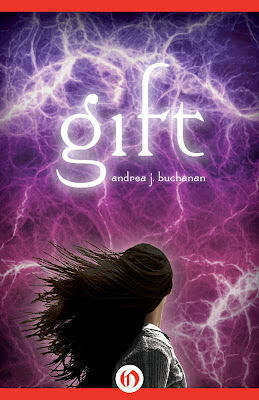
Gift by Andrea J. Buchanan

Gift is an exciting new project being released today, from Andrea J. Buchanan, author of The Daring Book for Girls.  Gift is a new multimedia paranormal YA novel which includes music by Fredrik Larsson, as well as art, videos, triggered events, and a graphic novel story. There's even a soundtrack and a playable Minecraft map available for download. Gift is not being promoted specifically as a transmedia project, at least not that I've seen, but with the variety of media included, and the addition of other media like the Minecraft map, it seems to me that it could qualify as one.

The enhanced ebook with the full feature set is only available for iBooks on iOS devices, but the story itself is available for a variety of ebook platforms, including Kindle, Nook, and Google (you may be able to buy the Google book from your local independent bookseller).

I haven't read Gift yet, but plan to. I just wish I had an iPad so that I could have the full experience.

Sunday, February 12, 2012

The Pool of Fire by John Christopher

The Pool of Fire is the third book in the Tripods series by John Christopher. I'm reposting my reviews in tribute to this great science fiction writer who died last week.

The Pool of Fire

by John Christopher


Time is running short, and the final push to overthrow the Tripods has begun. To do his part against the Masters, Will must risk his life and go back inside the city that he hoped never to see again, the city where he was a slave and where he saw so many horrors.

This book is a little more fragmented than the others - it's really several different episodes involving Will and his companions in the battle against the Tripods. But it's an exciting story, and anyone who enjoyed the first two books will enjoy this one. One of the things that makes Will such a likeable character is that he's an ordinary boy. He's not the smartest, or the most disciplined, or even the most heroic, but he still manages to be in the thick of the war, striking blow after blow against the tyrannical rulers of the Earth. Through Will we come to believe that anyone can be a hero.

Buy The Pool of Fire

More About John Christopher

Monday, February 06, 2012

The White Mountains by John Christopher


In tribute to science fiction writer John Christopher, who just passed away, I'm reposting my review of The White Mountains, the first book in his Tripods series.

Will Parker is 13 years old, and in another year he will undergo the capping ceremony, which marks the passage to adulthood. During the capping ceremony, the Tripods, giant metal beings with three legs, permanently fuse a metal cap to the person's skull. Will accepts the capping as a normal part of life, as everyone else does, until Jack, his best friend and cousin is capped. Seeing the changes in Jack makes Will nervous about what lies in store. Soon afterwards, he meets a vagrant who tells him that the Tripods are beings who have taken over the Earth and that the caps are the means they use to keep humans under control. He tells will about a colony of free humans living in the White Mountains, far to the south, and gives Will directions for how to get there. Accompanied by first one, and then another boy, Will sets off on a journey to find the free men in the White Mountains. The journey is fraught with peril and filled with adventures.


I first read this book when I was young, and reading it again as an adult I found it just as exciting as I remembered it. Will and his friends must be constantly alert to avoid Tripods and other dangers. Since the book is told from Will's point of view and we can "see" his throughts, he is the most thoroughly developed character. During the journey, he grows as he interacts with the other boys and also as he examines and questions his own beliefs, desires, and motivations. While the book doesn't have a strong female character, that didn't bother me when I was a kid. I just enjoyed the adventure, and still do. The only complaint I have about the book is that it ends too abruptly, and the ending is anticlimactic, almost like the author just said, "that's enough, I'll cut it off here."

One important note: John Christopher later wrote a prequel to the series called When the Tripods Came. The prequel is now marketed as book 1, and The White Mountains has been shifted to book 2. But do not read When the Tripods Came first! The White Mountains was originally intended to be the first book, and if you read the prequel first, it will diminish your enjoyment of The White Mountains, because part of the fun of the book is the mystery of the Tripods. If you read When the Tripods Came first, then you will know too much about the Tripods to enjoy The White Mountains the way it was originally intended to be read.

Buy The White Mountains:

Friday, April 08, 2011

Book Review: Thirteen Days to Midnight

Thirteen Days to Midnight
by Patrick Carman

Jacob Fielding can’t die. He can’t even suffer injury. His foster father transferred this amazing power to him just before they crashed into a tree, killing Mr. Fielding instantly. But while being indestructible sounds great, it has a darker side, as Jacob and his friends Milo and Oh (short for Ophelia) discover as they try to understand the power, then use it to help people. Death can’t be defeated; put on hold it lies in wait. And the three teens find that there is a terrible price to pay for trying.

Patrick Carman has a knack for writing gripping stories with lots of teen appeal. The straightforward writing style, combined with a dark and creepy story and credible teen characters, should make this a win with reluctant readers. Yet there’s enough depth and character development to also appeal to good readers who enjoy a creepy story. I like that Jacob, the narrator, is just an ordinary teen boy who does the kinds of things that teens do, like trying to impress the girl. Mr. Fielding never explained the power to Jacob, and as the three friends struggle to understand the “black lion,” as they call the power, they make mistakes that they will have to pay for in the end.

Thirteen Days to Midnight was a 2010 Cybils nominee in the Fantasy & Science Fiction—Teen category.

Buy Thirteen Days to Midnight from:

Amazon.com
Your local independent bookseller through IndieBound
Audio book from audible.com
Barnes & Noble

FTC required disclosure: Review copy provided by the publisher to enable me to write this review. The bookstore links above are affiliate links, and I earn a very small percentage of any sales made through the links. Neither of these things influenced my review.


Monday, April 04, 2011

Book Review: Firebrand

Firebrand
by Gillian Philip

Seth is the bastard sun of the dun captain Griogar. His father barely acknowledges his existence, and most of the people in the dun revile and torment him, when they aren't ignoring him. But when his older half-brother Conal takes him under his wing, the two form a special bond. So when Conal is exiled to the full-mortal realm, of course Seth goes with him.

Seth and Conal are Sithe, and have the ability to speak mind-to-mind. Sithe also live extremely long lives, but they aren't immortal and can die on the point of a sword—or in a fire. And in the late 16th century, full mortals consider Sithe abilities to be witchcraft, and witches are burned at the stake. Can Seth and Conal survive long enough to live out the term of their exile and return to their own world?

Firebrand is an exciting story driven by a strong narrative voice that leaps off the page. Seth is an interesting character: stubborn, arrogant, and temperamental, yet redeemed by an abiding loyalty to his brother. Although initially he appears to care about no one but himself, he grows through his love and loyalty to Conal, and he shows a deep ability to care in spite of his prickly exterior. Gillian Philip did an amazing job of creating a narrator who should be unlikeable, but whom we can’t help but begin to like and care about.

The plot is exciting, with enough action to keep the pages turning. In fact, it leaps right into the action as Conal is about to be burned at the stake, then much of the book is a flashback that shows how they got to that point. There’s also plenty of political intrigue, and romance as well.

Firebrand appears to be primarily only available in the UK at this time. I was lucky enough to receive a review copy as a Cybils panelist. There are some copies available on Amazon Marketplace, but other than that, readers in the US may have difficulty finding copies. I hope that this excellent fantasy series will be available in a US edition before too long.

Firebrand was a 2010 Cybils nominee in the Fantasy & Science Fiction—Teen category.

Firebrand on Amazon.com (try the used and new link)

Firebrand on Amazon UK

FTC required disclosure: Review copy provided by the publisher to enable me to write this review. Some of the bookstore links above are affiliate links, and I earn a very small percentage of any sales made through the links. Neither of these things influenced my review.


Friday, January 28, 2011

Book Review: Please Ignore Vera Dietz

Please Ignore Vera Dietz
by A.S. King

To say my friend died is one thing.

To say my friend screwed me over and then died five months later is another.

— Vera Dietz (from the prologue)

Vera's best friend Charlie is dead, and Vera has to live forever with the fact that she hated him at the end, that he rejected her and hurt her after a life-long friendship. While Vera tries to come to terms with his death and the events preceding it, she delivers pizzas, fights with her dad, makes out with an older guy at the town landmark pagoda, and secretly takes up drinking. She also has to deal with the thousand Charlies who visit her, trying to get her to clear his name. But Vera isn't ready yet, and isn't sure that she wants to.

Please Ignore Vera Dietz is a smart, intense book written in an authentic teen voice. Most of the book is narrated by Vera, but there are occasional interjections from Charlie, Vera's dad, and even the pagoda. Scenes in the present alternate with Vera's memories of past times with Charlie, memories that all have relevance to what happened in the end. Part of the pleasure of this book is the mystery; the truth is revealed gradually as the layers of exactly what happened are rolled back.

The truth that is revealed is horrible, and sad, and deep. This is a story of a lost soul, and maybe if the people around him had done things differently, it might have made a difference. And yet, as layer after layer is revealed, one also begins to see that the truth is complicated, and that knowing the right thing to do isn't always easy. In the end, this is a book that made me cry.

Recommended age range: teen

Please Ignore Vera Dietz was a 2010 Cybils nominee in the Fantasy/Science Fiction: Teen category.

FTC required disclosure: Book reviewed from library copy. The Amazon.com links above are Amazon Associate links, and I earn a very small percentage of any sales made through the links. Neither of these things influenced my review.


Monday, January 24, 2011

Book Review: The Curse of the Wendigo

The Curse of the Wendigo
The Monstrumologist, Book 2
by Rick Yancey

This sequel to last year's The Monstrumologist, finds Dr. Pellinore Warthrop, the Monstrumologist of the title, in the interesting position of arguing against the existence of a monster. When Warthrop receives word that his former mentor intends to propose adding the Wendigo, a mythical American monster that resembles a vampire in some ways, to the canon of Monstrumology at the next conference, Warthrop prepares a speech in opposition to the inclusion of such superstitious nonsense. When Warthrop's old friend John Chanler disappears on a quest for the Wendigo, Warthrop and his young assistant, narrator Will Henry, begin a dangerous journey through the Canadian wilderness in search of Chanler, even though Warthrop believes that search to be hopeless.

I've never been a fan of horror, but I love this series in spite of my squeamishness. I probably would never have picked up the first book, especially with it's original hideous cover, except for three things: it was nominated for the Cybils in 2009, I'm a fan of Rick Yancey (here, here, and here) and my teenage son, who also doesn't like horror, gave it his highest recommendation.

The series is wonderfully written, in a style reminiscent of classic horror, yet with a modern sensibility that will appeal to today's teens. There are some, er, pretty graphic scenes, so this isn't a series for younger children or sensitive readers.

For most of the book, The Curse of the Wendigo is slightly less of a bloodbath than the original Monstrumologist book, and moves a little more slowly, relying on suspense more than outright horror. However, there are still enough detailed descriptions of bodies with entrails hanging out and eyes removed to satisfy the most jaded horror reader.

But really, The Curse of the Wendigo is very much a character driven book. And what characters! I adore Will Henry. On the surface he is obsequious and timid, yet underneath he has a depth of resolve and courage, which is revealed to a much greater degree in this book. We also see Dr. Warthrop in new light here, as some of his past, and some unexpected aspects of his personality, are revealed. Through their hardships, his relationship with Will Henry develops, and while he is still the same arrogant and impatient doctor, by the end some change has crept in. There are some new characters introduced, including Lilly, a delightfully obnoxious 13-year-old girl who makes it her mission to torment Will, and who is certainly destined to be the first female Monstrumologist.

The Curse of the Wendigo was a 2010 Cybils nominee in the Fantasy/Science Fiction: Teen category.

FTC required disclosure: Review copy provided by the publisher to enable me to write this review. The Amazon.com links above are Amazon Associate links, and I earn a very small percentage of any sales made through the links. Neither of these things influenced my review.