Monday, May 19, 2014

Book Review: Dark Eden by Chris Beckett


Dark Eden
by Chris Beckett

Imagine a world with no sun. A world where the only heat and light comes from geothermal energy and bioluminescent plants and animals, and everything else is dark. Imagine a community of 532 people living on this planet, all descended from two astronauts who were stranded on the planet. (And yes, there was some incest in order for 532 people to be descended from only two.)

One hundred and sixty-three years after Tommy and Angela were stranded on Eden, their descendants still live in Circle Valley, where the landing vehicle originally came down, because Angela told the family to stay close, so that they could be found when rescue arrived from Earth. Food in Circle Valley is running out, but outside of Circle Valley is the Snowy Dark, and no one has ever crossed the Snowy Dark to find out what (if anything) lies beyond. Everyone in Family fears to leave the valley, lest they be stranded when the rescue comes from Earth.

Everyone except teen ("newhair") John Redlantern. John feels suffocated in the closeness and stagnation of family, and he asks the questions that everyone else is afraid to ask. No one will listen, so John does the unthinkable, with consequences that will affect everyone in Family and cause lasting change.

Dark Eden is a compelling story and a fascinating study of a society with characteristics derived from its unique environment, as well as from its tragic origin story. As the book progresses, it starts to become clear that the origin story portrays a very dysfunctional family. How would it affect an entire society to be based on such dysfunctional origins?

The worldbuilding is amazing. Although I have trouble imagining how a planet like Eden could exist, every detail of the world is so well developed, the ecosystem consistent and logical, that it came across as fully realized and believable. All that detail is developed very naturally through the story and the characters; there are no infodumps. The society, culture, and language are all distinctive and consistent.

The characters are interesting, diverse, and well-developed. John Redlantern is a bit of an anti-hero. Although he is honestly trying to help Family, he acts also out of self-interest, restlessness, and a compulsion for change. John's sometimes-lover and co-conspirator, Tina Spiketree, is an equally interesting and complex character. In addition to John and Tina, there is a rich tapestry of well-developed characters, some of whom become point-of-view characters for a short time.

Story is an important theme running throughout Dark Eden. Obviously the origin story plays a significant role. As in many cultures, the stories from the past are retold and reenacted at important events. These stories are distorted by the lens of time, and by people who don't really understand, in some cases, what the stories mean, because they have no experience with things that could form a basis for understanding. John Redlantern is keenly aware of the power of story; he consciously makes choices that will make him a mythic character to other people, and he wonders how his descendants will tell his story in the future.

The title of the book fits on multiple levels. The planet is named Eden, and obviously Tommy and Angela are its Adam and Eve. But Earth is the Eden that they've been exiled from. The Family doesn't seem to have a religion or worship any gods, but waiting for the return to Earth has an almost religious fervor to it. Later in the book, there is also a kind of Cain and Abel vibe happening.

Dark Eden is an astonishing, compelling, and unique science-fiction story. If you like science fiction and this isn't on your TBR, it probably should be.

Note: Dark Eden is published for the adult market, but I think it has crossover appeal for teens. Besides the teen protagonists, it has a teen outlook and themes of social change that will appeal to teens. There is some fairly explicit sex, so it would be best for mature teens, but sex is not uncommon in YA today. And in spite of the explicit nature of the sex, it's some of the least sexy sex I've read in books — it's supposed to be, because it's another symptom of the stagnation of this society.

Diversity?

  • Mother Angela was black, according to the stories, and Tommy was white (Jewish, if I remember right). One minor character in the Family is described as being a "dark bloke with dark curly hair," but other than that, I didn't see any other mention of racial characteristics. Given the description of Angela and Tommy, I think it's safe to assume that everyone in Family would have multiracial characteristics.
  • Nations are mentioned in the stories from the past, but because the people in Family have no basis for understanding — their closest analogue is the smaller groups within Family —it doesn't really pay a role.
  • At one point, Tina is thinking about how all of the boys want to "slip" (have sex) with her, and then she adds, "except those who prefer boys." Although I didn't notice any same-sex couplings in the book, it seems that in this society they're accepted as routine.
  • Cleft lip and club foot are common congenital deformities in Family, probably due to the incest and inbreeding. These play a significant role in the story. The effect of the deformities on the individuals is shown, without it degenerating into stereotypes. And they are individuals, who have distinctive personalities of which the disability is only a facet. One adult character is angry and mean as a result of bullying in childhood, but others are caring, respected members of society. One boy with clubfoot who appears to be an object of pity in the beginning ends up becoming a leader.
Who would like this book:

Mature teens and adults who enjoy unique science fiction with richly developed worldbuilding and characters

Get it from:
Audiobook

FTC required disclosure: Review copy sent by the publisher to enable me to write this review. The bookstore links above are affiliate links, and I earn a very small percentage of any sales made through the links. Neither of these things influenced my review.

Thursday, May 08, 2014

Book Review: In the Shadows


In the Shadows
Text Story by Kiersten White
Art and Art Story by Jim Di Bartolo

In the Shadows alternates between two related stories, one told in text and the other entirely in pictures. It's hard to talk about In the Shadows without risking revealing too much. The stories themselves unfold gradually, and at first it's hard to understand what's going on or how the stories fit together, but as the details unfold the pieces start to come together.

The text portion alternates between five young people: Cora and Minnie, whose mother runs a boarding house in a small town in Maine; Arthur, a mysterious young man who comes to the boarding house; and two brothers, Thom and Charles. Charles is dying from a terminal illness, and their father sends the two young men from New York City to Maine for Charles' health, although a conversation that Thom overhears between his father and a woman seems to indicate a more sinister reason. The five teens begin to suspect that there is evil lurking in the town, and all five of them are linked to it in some way.

The art story depicts a young man traveling around the world, apparently searching for something or someone. We don't know who he is, and at first it's hard to understand what's going on or what the connection is with the text story. By about halfway through, you begin to suspect, and then later details in the text story make clear what's happening in the art story.

In the Shadows is an intriguing, beautifully made book. I love this kind of story, where the connections aren't always clear and you have to puzzle it out as you go along. I actually found that after I finished the book, I wanted to go through the art story again from the beginning to pick up on all the details and fully appreciate it.

The text story is well-written and holds your interest, the art is beautiful, and the two fit well together stylistically. There is a dark, creepy, and mysterious feel to both stories. With evil lurking in a small town in Maine, it's hard not to compare this to Stephen King, but stylistically it's not really similar to King's writing. The compelling story and short chapters conspire to keep you reading; "Just one more chapter," I kept telling myself.

Diversity?

Other than a few incidental characters in the pictures, I didn't see any diversity.

Who would like this book:

With the short chapters, artwork, and fast-paced read, this may be a good book for reluctant readers. Graphic novel readers may also enjoy it, even though it isn't strictly a graphic novel. Any teen or adult who enjoys dark, creepy stories with mysterious conspiracies will enjoy In the Shadows.

Get it from:
FTC required disclosure: Review copy sent by the publisher to enable me to write this review. The bookstore links above are affiliate links, and I earn a very small percentage of any sales made through the links. Neither of these things influenced my review.

Monday, May 05, 2014

Book Review: Rose and the Lost Princess


Rose and the Lost Princess
by Holly Webb

In the first book, Rose was thrilled to be selected for a position as a housemaid for a prominent magician. As an orphan, her dream was to get out of the orphanage and earn her own living. But when she discovered that she has an inherent talent for magic, Rose had mixed feelings. Magic is exciting, but also so far outside her experience that it makes her uncomfortable. Although Rose is now an apprentice to the magician, Mr. Fountain, she wanted to keep her position as a housemaid in the house. Besides providing her income, she's not quite ready to let go of her ordinary, normal life.

But now that the other servants know that she is magic, they don't want to have anything to do with her. Most ignore her, and some are actively antagonistic. Only Bill the houseboy is still friendly. To make matters worse, there is a growing anti-magic movement in the aftermath of the events of the first book. It's not a good time to be a magician. People are blaming the early winter and heavy snowfall on magic, and when the beloved Princess disappears, and is found again, the whole country is in a frenzy, convinced that magic is involved. The King is worried that there will be another attempt on the Princess, so Rose is sent to the palace to stay with the Princess, because as another young girl she can provide some magical protection while seeming to be an ordinary housemaid and companion for the Princess.

Rose and the Lost Princess is a delightful book that I enjoyed even more than its predecessor. Rose is such a great character. She loves the magic, and yet she's a very no-nonsense, practical girl. She's what Mary Poppins might have been like as a girl. The book is extremely well-written and immersive. There's gentle humor, much of it provided by Gus, the magical cat. In many ways it's a perfect middle-grade novel. Even as an adult I quite enjoyed reading it, and I'm looking forward to future books in the series.

Diversity?

I didn't see any diversity of color or ethnicity, but then, Victorian-type settings tend to be pretty monochrome. Sexuality simply doesn't come into the book, other than Rose's hand on Bill's arm at one point, so there's not really any opportunity for sexual diversity.

There is diversity of class, and in fact class is one of the themes in this novel. As a servant who is also an apprentice to a powerful magician who is a councilor to the King, Rose is caught between classes in a most uncomfortable way. The lives of both the upper and lower classes are vividly portrayed, from the glittering palace to the lives of Mr. Fountain's servants downstairs. The effect of power on the powerless is shown in small ways, including the house manager's not-so-subtle threat to a servant who is threatening to leave, "How will you get a new position without references?"

Who would like this book:

Middle-grade readers who love an immersive, character-driven fantasy. There's enough excitement to keep anyone interested, but it's not overly violent or scary, so it should be fine for sensitive readers. Although the protagonist is a girl, I think that boys will enjoy it as well, if they can get past the girl on the cover and the feminine name, "Rose." (Edited to add: the first book has an evil magician kidnapping children and drinking their blood, so sensitive readers may want to skip that one and start with this one.)

My review of Rose, the first book in the series.

Get it from:
FTC required disclosure: Review copy sent by the publisher to enable me to write this review. The bookstore links above are affiliate links, and I earn a very small percentage of any sales made through the links. Neither of these things influenced my review.

Tuesday, April 01, 2014

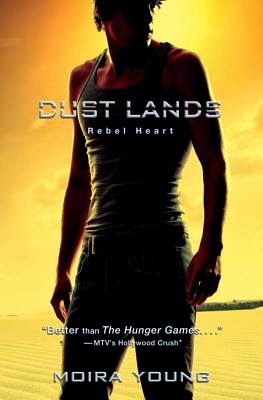
Book Review: Rebel Heart


Rebel Heart
Dust Lands Book 2
by Moira Young

Warning: this review may contain spoilers for the first book, Blood Red Road. If you haven't read Blood Red Road, I highly recommend it! It's about an incredibly tough heroine on a quest to save her brother in a post-apocalyptic wasteland. 

In Blood Red Road, Saba had one goal: find and save her twin brother Lugh from the people who took him. Saba knew that once she found Lugh, everything would be all right. But everything is most definitely not all right. Lugh and Saba have both been changed by the traumatic things they experienced, and the bond that connected them their whole lives seems to be broken and unrepairable.

Saba and Lugh, along with younger sister Emmi and another young man, Tommo, are on their way west to start a new life. Jack, whom Saba recently discovered is her heart's desire, separated from them to take a hard journey to deliver bad news, but he promised to meet them in the west. Saba is desperate to go west and find Jack again, but the group is stuck in the Waste, waiting for an injured horse to heal.

Then word comes that the Tonton, so recently defeated by Saba and her friends, have a new leader, who is cleansing the land of everyone except his own followers, killing or driving out the weak and the old, and taking the young and healthy. What's worse, Jack has been seen with the Tonton and may be one of them. Saba can't believe that Jack would be a part of such horrors, and she's determined to go back and find the truth, and help if she can.

Like Blood Red Road, Rebel Heart is a roller coaster of a story that grabs you and won't let go. Saba is one of the best YA heroines I've ever read. She's tough, oh yes, she's tough, but she also has heart and depth and an unshakeable resolve. Saba is a flawed heroine. She makes mistakes, she's not always kind, and she sometimes lets her single mindedness blind her. But Saba is a person who cares deeply, and would do anything for her family and her friends.

As with the first book, Rebel Heart is told in first person in Saba's distinctive voice and dialect, which is a little difficult to read at first, but it doesn't take long to seem natural, and it's such an integral part of the book that it's hard to imagine this book without it. The entire book is also written without quotation marks. All dialog is simply written out as part of the text with nothing to set it off. This also seems odd at first, but you get used to it and don't notice it. The biggest effect, to me, is that with the breakneck pace of the novel, the lack of quotation marks to slow the eye down contributes to a feeling of going downhill without brakes.

Overall, Rebel Heart and its predecessor, Blood Red Road, are excellent books that will have strong appeal to anyone who enjoys dystopian YA literature. Although more post-apocalyptic than dystopian, there are some dystopian elements in the Tonton society ruled by their new charismatic leader, the Pathfinder, and the book has a dystopian feel to it.

Rebel Heart ends on a bit of a cliffhanger, and the third book, Raging Star, is due out May 13. I can't wait to read it!

Who would like this book:

Anyone who enjoys young adult dystopian books and who doesn't mind the unusual punctuation and dialect.

Rebel Heart is a 2013 Cybils Awards Nominee. The first book, Blood Red Road, was the 2011 Cybils winner for YA Science Fiction & Fantasy.

Get it from:
Audiobook:

Rebel Heart is available as an audiobook from Audible.com. I haven't yet listened to the audiobook, but I did listen to the audiobook for Blood Red Road and thought it was very well done. Narrator Heather Lind did an excellent job. There appears to also be a version narrated by Moira Young, but Audible tells me it isn't available in my area, so I suspect it's the Canadian version. The links below are to the Heather Lind narrated version.
FTC required disclosure: Reviewed from purchased copy. The bookstore links above are affiliate links, and I earn a very small percentage of any sales made through the links. Neither of these things influenced my review.
Friday, March 28, 2014

Thoughts on BookExpo America and BookCon

So, yesterday I read this article in PW about Reed Exhibitions' plans for the new BookCon on the last day of BookExpo America (BEA). I posted an off-hand comment on Twitter and Facebook that I thought the new plan was great. Apparently, my comments weren't clear, and some people are confused and upset by the new plan. "Why is excluding the public a good thing?" I was asked, and that wasn't what I meant at all, and I don't think it's what BEA intended. In fact rather the opposite. BEA is working to include the public and craft a positive experience for them. Since it's difficult to clarify my thoughts in 140 characters, I thought I'd write a blog post.

First, some history: BookExpo America is the largest U.S. conference for the book industry. It started in 1901 as the American Booksellers Association convention, and eventually grew to encompass much more. But it has always been a conference exclusively for the book industry. To attend, you had to be a bookseller, librarian, publisher, publishing service provider, or someone else working in the industry. Attending wasn't cheap, either. Badges can run several hundred dollars, depending on your role. That wasn't intended to be exclusionary. It was always a conference oriented around the business side of books.

However, since books and authors are a big part of the conference, I think increasingly so in recent years, BEA recognizes that it would also be of interest to passionate book lovers, and in turn, those are people whom publishers exhibiting at BEA would like to reach. So for the last year or two, they've been experimenting with opening the conference to the public.

Last year, that took the form of "Power Reader" day, which provided tickets giving power readers access to the show floor on the last day. I think that Power Reader Day both was and wasn't a success. I think the idea was great, and some publishers took advantage of the opportunity to interact with readers and have special events and giveaways just for the public. For the readers, it provided a chance to meet authors and get autographed books, as well as a peek behind the curtain to see books in advance of publication.

However, the problem was that the BEA show floor is very large, and many exhibitors are not of interest to the public, nor are they interested in interacting with the public. So I saw many power readers wandering around booths with remainders dealers, printers, distributors, app developers, book display manufacturers, and publishing service providers of various types. In addition, some publishers publish books not intended for a general audience, and even some of the ones that do publish general interest books didn't seem interested in interacting with the public. Many exhibitors break down early on the last day, and walking the floor and hearing the tape guns, some starting as early as 11-12:00, I couldn't help but think that if I were a Power Reader, I would have been disappointed to see what looked like a conference winding down, on the only day I could be there.

Thankfully, Reed Exhibitions also recognized this problem, and they made some changes to address it. This year, if I understand correctly, a part of the BEA show floor will be sectioned off as the area for BookCon (replacing Power Readers) attendees. Exhibitors are given a choice whether they want to be in the BookCon area or not. The ones that choose not to be in this area are ones that wouldn't be offering anything to the public anyway: the business to business service providers, the specialized publishers, and those general trade publishers who, for whatever reason, aren't interested in taking part.

So if you attended Power Reader day last year and are worried about the changes, you won't be losing anything! (Disclaimer: I'm not associated with BEA in any way, other than as an attendee for the last 10 years, so I'm just going by what I read in the press and on their website). You'll still have access to a feast of books and authors; it's just that it will all be consolidated into one area, so that you don't have to hunt through aisles and aisles of irrelevant (to you) booths to find the things that interest you.

I think that what's confusing people is on the ticket page it says, "BookCon Tickets do not provide access to BookExpo America (BEA). BEA is a trade only event (not open to the public) and BookCon Tickets do not provide entry into BEA." What I think this means - and again, this is just me interpreting - is that you don't have access to the first two days of BEA, which Power Readers didn't have last year, either, and you don't have access to the area of BEA which is primarily for business to business exhibitors (which most of the public wouldn't be interested in anyway).

This BookCon FAQ addresses a lot of the questions and concerns.

If you haven't attended before and you're within an easy drive of New York City, this is a great opportunity to find out about new books, meet authors, and maybe pick up some freebies. Tickets to the one day BookCon event are only $30 for adults (and teens, apparently) and $5 for children. Ticket information is here.


Monday, March 24, 2014

Book Review: Underneath

Underneath

by Sarah Jamila Stevenson

Sunny Pryce-Shah is devastated when her cousin Shiri commits suicide. How could Shiri do it? Shiri always seemed so confident, and Sunny looked up to her older cousin. Then Sunny starts to hear thoughts, and from cryptic comments in Shiri's journal, she suspects that Shiri may have had the same problem. Hearing thoughts is more of a curse than a power. It can be painful to know what people really think of you, for example, and Sunny can't control it or stop it from happening. Sunny is already dealing with so much, but she knows that she has to get the ability under some kind of control before it pulls her apart like it did her cousin.

Underneath is a contemporary YA novel with a speculative twist. The underhearing is just one of the conflicts Sunny has to deal with. In addition to grief over her cousin and dealing with her unusual problem, Sunny also has to navigate the treacherous waters of the high school social scene, and her family is dealing with the possible spousal abuse of her aunt. The relationships, including family, friend, and romantic interest, feel authentic, and I like that the book portrays how complex such relationships are. Fights happen, and sometimes no one is right or wrong and you just have to find a way to work things out. But sometimes one person's behavior is wrong, and it's not always easy to tell the difference.

The book also portrays grief in a way that seems authentic. Grief doesn't just go away because a certain amount of time has passed, and one of the difficult things for someone bereaved is when people start to feel that they should be over it. Grief also takes different forms, and different people grieve in different ways at different times.

I also like that romance isn't a major focus of the story. There are romantic interests, and even a couple of love triangles, but in the end it's not important who ends up paired with whom, and the story is really much more about friendship (and family) than romance.

From a diversity perspective, Sunny is half Pakistani. Although she is pretty much a regular American teenager, there are some bits of Pakistani culture that come from her grandparents, for example when they send over Pakistani food, or request an imam at the funeral. It's handled very naturally as a part of the normal American experience and not at all an issue.

In the end, it's character and voice that make this a compelling novel. Sunny is such an interesting character with a distinctive voice, and we feel her pain and her struggles.

The underhearing itself is never explained, and this may bother some readers. However, not understanding it is a part of the story conflict, and in real life there isn't always a neat explanation that ties things up with a bow.  I do love the word "underhearing" - it's a perfect word for what is, in essence, mental overhearing.

Who would like this book:

Teens who enjoy contemporary fiction with a paranormal twist.

Underneath is a 2013 Cybils Awards Nominee

Get it from:
FTC required disclosure: Reviewed from library copy. The author is an online friend that I've met several times at conferences. The bookstore links above are affiliate links, and I earn a very small percentage of any sales made through the links. Neither of these things influenced my review.

Friday, March 21, 2014

The Infinite Sea Cover Reveal


The cover for The Infinite Sea, sequel to Rick Yancey's The 5th Wave, has been revealed. You can see a larger image of it over at USA Today, along with an interesting interview with Rick Yancey. (Note: Although Yancey tries to be careful not to spoil anything, I think it does give some clues about the second book).

The 5th Wave was an excellent book about the aftermath of an alien invasion, although one of the themes of the book is that this alien invasion is not a anything like what you would expect from movies and TV. ("...not-your-grandma's alien invasion," as Yancey says in the interview). You can read my review of The 5th Wave here.

I'm really looking forward to reading The Infinite Sea, which will be published September 16. I'm particularly excited that Yancey mentions in the interview that there are still some plot twists, as one of the things I loved about the first book was the layers of surprising reveals.

Also, Yancey talks about the 5th Wave movie in the interview, and it sounds like that's making progress.

Tuesday, March 18, 2014

Light of the White Bear Kickstarter Project


David Clement-Davies, author of The Sight, Fell, and Fire Bringer, is running a Kickstarter project to bring his newest book, Light of the White Bear, to the United States. I've read several of his books and really enjoyed them. If you like books about wild animals, with deep social and spiritual themes, you'll enjoy his books.

If you'd like to support an author fighting for autonomy over his books, or if you just like his books (or think you might!) please consider backing this Kickstarter.
https://www.kickstarter.com/projects/1159695087/light-of-the-white-bear

Saturday, March 08, 2014

Petition to Stop Gender-labeling Books


The UK based organization Let Toys Be Toys has started a petition on Change.org to ask publishers to stop gender-labeling books. The image above shows how such labeling can send a powerful message to kids about what's important: beauty for girls and intelligence for boys in this case. Granted, this image is an extreme example, probably selected for its provocative nature. But any gender labeling, even less provocative examples, limits children's choices and perpetuates gender stereotypes. Please take a few minutes and sign this petition.

Here's a great article about gender labeling on the Let Toys Be Toys website.

As a child, I always preferred books with robots, aliens, and adventure over cupcakes, flowers, and handbags. Books should expand children's horizons, not limit them.

Monday, February 17, 2014

Book Review: The Summer Prince

The Summer Prince
by Alaya Dawn Johnson

June and her best friend Gil are thrilled to wrangle an invite to the official celebration of the newly elected Summer King, Enki. But they never anticipate that Gil and Enki will fall in love, or how much Enki will affect both of their lives. Although the Summer King has no real power, Enki, who comes from the lowest level of society, is determined to use what influence he has to help his people. June and Enki begin to collaborate on a big art installation, one that they hope will both send a message to the city, and win June the Queen's Award. But none of the three can forget that at the end of the summer, Enki will die. Because the real purpose of the Summer King is sacrifice in service of the city.

The Summer Prince is a brilliant book on so many levels. To start, it's an achingly immersive story set in a future Brazil. Added to that are elements from the Sumerian myth The Epic of Gilgamesh. Going deeper, there are the themes: power and sacrifice, choices and consequences, privilege and class, order and change. Finally, there is the writing: Alaya Dawn Johnson has created a beautiful tapestry so intricately woven that the patterns aren't always obvious on the first read-through. Even on my second read I'm not sure if I saw everything.

Palmares Tres is a gem of a city where past culture and future culture merge. It's a city where people still Samba and eat Vatapá stew, where grafeteiros create masterpieces and street gangs fight with capoeira. And yet it's a city with deep class divisions, where class hierarchy is literally expressed in the city tiers: the higher classes live on the upper levels and the lowest class lives on the bottom tier, where the the stink of the algae vats is ever present. This physical expression of class hierarchy is not a new idea in science fiction, but it's well done here. That stink, known as the Catinga, becomes a powerful symbol in the story, and in fact the higher tiers call the lowest tier "The Catinga."

Palmeres Tres is a city ruled by a matriarchy: a Queen and a council of women called Aunties. Many of them have forgotten the purpose of power, and while they, in their own way, seem to love the city, often their machinations seem designed to protect their own power rather than benefit the city. Most residents of the city live 200 years or more, setting up a situation where anyone under 30 is considered a juvenile, and not to be trusted to make good decisions. So we have class conflict, gender conflict, and age conflict, and with his election as Summer King, Enki becomes the touchstone at the center of all these conflicts.

I've seen this book described as dystopian, but I don't think that it quite falls into that classification. The traditional definition of a dystopia is one that seems utopian on the surface, but is later revealed to be oppressive and deeply flawed. I think that in some ways The Summer Prince turns that around: the flaws are fairly obvious early on, but as you continue to read it becomes clear how much the citizens of Palmeros Tres love their city with a genuine love, even in spite of the flaws. However, The Summer Prince is similar enough to dystopian literature that I think it will appeal to teens who enjoy dystopian books.

It's not necessary to be familiar with The Epic of Gilgamesh or to even recognize those elements are there to enjoy the story, but if you are familiar with the Epic it's a sheer joy to discover the iconic story of Enkidu and Gilgamesh wrestling in the streets transformed into a heart-stopping Samba when Gil and Enki first meet. The Summer Prince is not really a retelling of the myth, but there are some interesting parallels.

June is an imperfect character who struggles throughout the book to make the right choices. Her dream is to be recognized as a great artist, and when that dream comes into conflict with her awakening social awareness, she doesn't always choose the right thing. She blames her mother for her father's death, and because of that she's mean to her mother. All these things make her a believable, realistic character whom the reader can identify with as she grows through her association with Enki.

The Summer Prince does a great job of representing people who are underrepresented in YA lit. All the residents of Palmeros Tres have skin of varying shades of color, and Enki himself is described as being exceptionally charismatic and with very dark skin. Sexual relationships, both same-sex and opposite-sex, are depicted in a natural, unfettered way that's totally a non-issue. In Palmeros Tres it doesn't seem to matter whom you love.

The Brazilian setting is a refreshing change from books set in European-based settings. I personally loved that the book represented a culture and people that you don't often see in American YA Fiction, but I'd be remiss if I didn't point out this review of The Summer Prince by a native Brazilian, Ana of The Book Smugglers. I'd encourage you to read the review, but in short, Ana is concerned that the Brazilian cultural elements are not always used accurately, and don't go any deeper than those elements that outsiders identify with Brazil, such as samba, Carnival, and capoeira. To Ana, it feels like a stereotype.

I've been thinking a lot about Ana's review over the last few days. Does the book stereotype Brazilians? Maybe - it's hard for me to know since I'm not Brazilian. Should a writer be able to write about a culture as an outsider to that culture? This, I think, is the crux of the controversy, and I've seen good arguments on both sides. I personally think writers stretching to write about things outside their personal experience is a good thing, because it helps to bring those ideas and cultures to other people who are not familiar with them, but the outsider has to work harder to get it right. I found an interview with Johnson where she says about her research, "I read a lot of books, particularly about the history of the African diaspora in Brazil. Also got advice from my sister, who studied in Brazil and knew many sources. And sent it to Brazilian writers for help."

I totally understand Ana's frustration and annoyance with the book. It's not quite the same thing, but I studied a martial art for 18 years, and I get really annoyed when I read a fiction book that gets the martial arts details wrong. So I get how frustrating it would be to have your culture portrayed inaccurately. But it does sound like Johnson did try get the details right, and I hope that maybe it will at least it will inspire young people to want to learn more about Brazil and read up on it, as I did after finishing the book. In balance, I think that a book like this that encourages young people to think outside their comfort zone and learn about new ideas and new cultures is a good thing. There are no easy answers, but I think it's important that we keep having these conversations as we try to get it right.

The Summer Prince is the 2013 Cybils Awards winner for the YA Speculative Fiction category.

Who would like this book:

Science fiction and dystopian readers, as well as teens who like reading about other cultures.

Get it from:
Audiobook:


FTC required disclosure: Review copy sent by the publisher for the purpose of Cybils Awards judging. The bookstore links above are affiliate links, and I earn a very small percentage of any sales made through the links. Neither of these things influenced my review.